Source :
Die Deutsche Wochenschau No. 720 - 21 June 1944
https://www.youtube.com/watch?v=e-DzDJmt5F8
Wehrmacht, Heer, Luftwaffe, Kriegsmarine, Waffen-SS, Nazi, Third Reich, SS, Schutzstaffel, Soldat, Panzertruppen, Gebirgsjäger, Fallschirmjäger, Panzer, U-Boat, Sailor, Matrosen, Soldaten, Soldiers, Ritterkreuz, Knights Cross, Medals, Battle, War, World War II, Stalingrad, Berlin, Eastern Front, Western Front, Adolf Hitler, Erwin Rommel, Erich von Manstein, German, Adler, Uniforms, Tanks, Battlefield, Blog, Website, Axis, Ace, Aces, Experten
Sunday, May 18, 2025
Rest Village Behind the Front Line
Wednesday, January 31, 2024
Wehrmacht Soldiers Marching in the Netherlands
Source :
https://beeldbankwo2.nl/nl/beelden/?q=wehrmacht&mode=gallery&view=horizontal
Tuesday, June 20, 2023
Studio Portrait of Panzertruppen
WAFFEN-SS
Source :
https://www.generalassaultmilitaria.com/product-category/photos/
Studio Portrait of Stahlhelm in Wear
Source :
https://www.generalassaultmilitaria.com/product-category/photos/
Studio Portrait of Heer Personnel

Heer Panzergrenadier portrait with DRL-Sportabzeichen, Westwall ribbon and Panzerkampfabzeichen in wear.

Goldenes-Parteiabzeichen + Wehrwirtschaftsführer Abzeichen Portrait. Interesting Pionier portrait with Golden party badge, Defense economy leader badge, Ostmedaille ribbon, Kriegsverdienstkreuz II.Klasse ribbon and wound badge. Very rare combination of awards that is almost never seen, let alone on a combat uniform! Dated May 1944.
Source :
https://www.generalassaultmilitaria.com/product/heer-infantry-portrait-with-silver-iab-in-wear/
Sunday, April 9, 2023
German Soldiers in the Trenches
Wehrmacht Briefing
Sunday, April 2, 2023
Wehrmacht Soldiers and Sailors Listening to the Speech of Hermann Göring
Reichsmarschall Hermann Göring (Oberbefehlshaber der Luftwaffe) spoke to the German Wehrmacht. On January 30, 1943, on the 10th anniversary of Adolf Hitler's assumption of power, Reichsmarschall Göring spoke to the German Wehrmacht in the ballroom of the Reich Aviation Ministry. View into the ranks of the representatives of the Wehrmacht, who listen to the striking words of the Reich Marshal.Source :
https://beeldbankwo2.nl/nl/beelden/?q=wehrmacht&mode=gallery&view=horizontal
Sunday, March 26, 2023
German Soldiers in Akershus Fortress Norway
Quay below Akershus fortress. Akershus Fortress is a medieval castle in the Norwegian capital Oslo that was built to protect and provide a royal residence for the city. The fortress has never successfully been besieged by a foreign enemy. However it surrendered without combat to Nazi Germany in 1940 when the Norwegian government evacuated the capital in the face of the unprovoked German assault on Denmark and Norway.Source :
https://beeldbankwo2.nl/nl/beelden/?q=wehrmacht&mode=gallery&view=horizontal
https://en.wikipedia.org/wiki/Akershus_Fortress
https://www.klikk.no/produkthjemmesider/vimenn/tatt-pa-senga-da-tyskerne-angrep-norge-2859155
https://www.politico.com/news/magazine/2022/09/23/henry-morgenthau-roosevelt-government-europes-jews-00058206
Saturday, February 18, 2023
Why German Soldiers Fought with their Sleeves Rolled up
To date, there are not so many people left who remember and saw with their own eyes the events of the Second World War, and you and I, the descendants, can only observe the events of those years from documentary chronicles, photographs, or from artistic paintings that were shot in Soviet Union or already in our time.
Surely, many of you have noticed how German soldiers appeared in newsreels with a proud expression on their faces, leisurely walking with an MP40 machine gun in their hands. And almost always their sleeves were rolled up to the elbow, while Soviet soldiers never did this.
What is the reason for such wearing of military clothes. I would like to note right away that in this situation we are not talking about any military traditions. It was all about the form itself.
The fabric from which the German uniform was sewn consisted of two-thirds of wool, the rest of viscose. The quality and characteristics of the appearance of the clothes were at a high level. In the cold season, in this form it was quite warm, but this plus turned into a minus at the same time. Heat transfer is disturbed in woolen products and because of this, it was very hot in a woolen military uniform in the warm season, unlike cotton clothes. Toward the middle of the war, the German uniform began to be sewn, it was from cotton, but the rolling up of the sleeves by the Wehrmacht soldiers on the tunic had already become a habit. Apparently, the charter did not prohibit such wearing of a military uniform, and the officers turned a blind eye to this. However, discomfort in warm weather is not the only reason for rolling up sleeves. We all know that natural wool is a rather prickly material, and those who have worn a wool sweater on their naked body at least once understand what is at stake and remember how the skin itches after that.
As for the soldiers of the Red Army, their uniforms were sewn almost entirely from cotton fabric, as a result of which it was much lighter and more practical. Cotton also breathed well, was a versatile fabric for heat and cold. Plus, the tunics of Soviet soldiers were distinguished by a special cut. The sleeves were slightly tapered, so rolling up the sleeves was quite difficult and impractical.
Source :
https://dzen.ru/media/id/5fdf902d0199050378ad334d/pochemu-nemeckie-soldaty-voevali-zasuchiv-rukava-60771d448fb1c273054dd6bb
https://en.wikipedia.org/wiki/File:German_troops_in_Russia_-_NARA_-_540156_(cropped).tif
Saturday, November 12, 2022
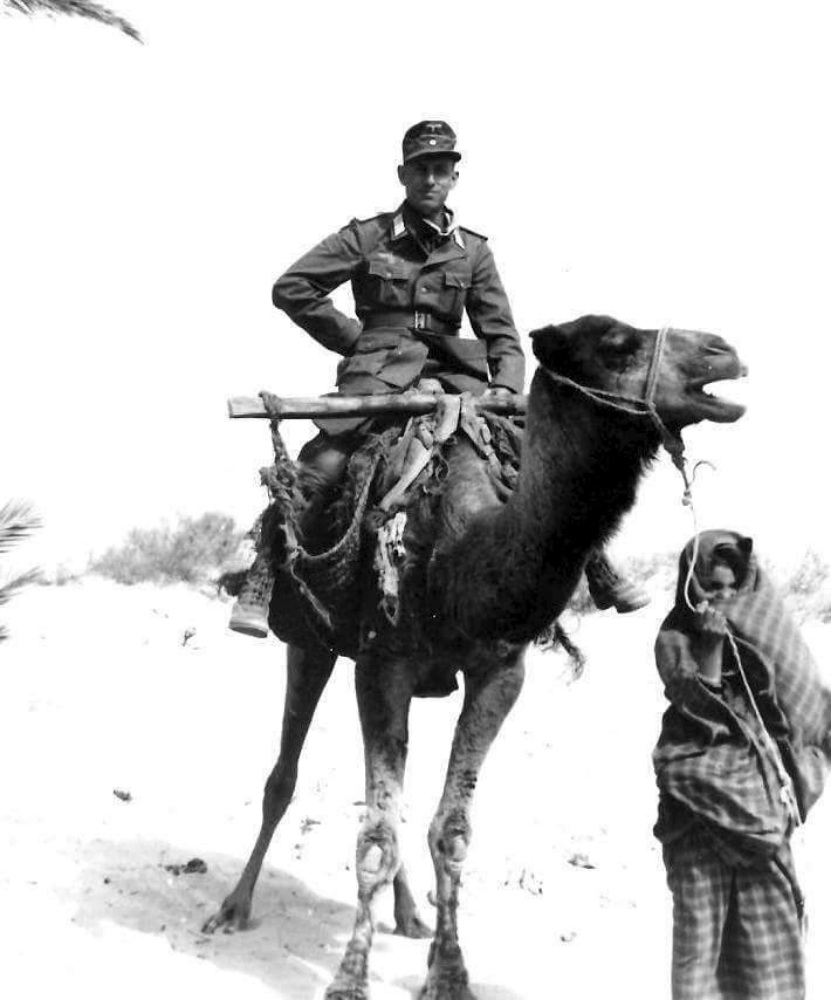
Afrikakorps Soldier on a Camel with a Guide

An Afrikakorps soldier on a camel with a guide. The Germans and Italians more or less left the Arab populations to themselves, so long as they did not interfere with operations in the area. The German command also instructed soldiers not to fraternize with the local populations. However, a sizable number of Arabs volunteered to fight in the Afrika Korps in the ‘Free Arab Legion,’ later in Panzerarmee Afrika, and smaller numbers served as translators or guides.
Source :
http://www.mourningtheancient.com/truth1cb2.htm
https://www.quora.com/How-did-the-Afrika-Korps-and-Italian-troops-treat-local-populations-during-the-North-African-campaign
Tuesday, October 25, 2022
Happy German Soldiers in Yugoslavia
German soldiers, confident of success shortly before the end of combats, in Yugoslavia during Operation Marita, 14 April 1941. The Axis victory was swift. As early as 14 April the Yugoslav high command had decided to seek an armistice and authorised the army and army group commanders to negotiate local ceasefires. That day the commanders of the 2nd and 5th Armies asked the Germans for terms, but were rejected. Only unconditional surrender could form the basis for negotiations they were told. That evening, the high command sent an emissary to the headquarters of the Panzergruppe 1 to ask for armistice, and in response General Ewald von Kleist sent the commander of the 2nd Army, Maximilian von Weichs, to Belgrade to negotiate terms. He arrived on the afternoon of 15 April and drew up an armistice based on unconditional surrender. This picture was taken by Kriegsberichter Artur Grimm and first published in SIGNAL magazine.Source :
https://en.wikipedia.org/wiki/Invasion_of_Yugoslavia
https://id.pinterest.com/pin/352969689554597002/
Sunday, October 23, 2022
Afrikakorps Soldiers with Sand Protector
Goggles, scarves and headdresses were indespensible for blocking sand and the sun, and for preventing sun strokes. The heat often caused mirages. The wind, named "ghibli" by the Italians, could blow at more than 150 km/hours and caused terrible sand-storm, which could last up to three days. The picture was taken by Kriegsberichter Albrecht Heinrich Otto of PK (Propaganda-Kompanie) "Afrika" in April 1941.
Source :
"Deutsche Afrikakorps (1941-1943)" by Ricardo Recio Cardona
https://commons.wikimedia.org/wiki/File:Bundesarchiv_Bild_101I-785-0285-14A,_Nordafrika,_Soldat_mit_Sandschutz.2.jpg
Afrikakorps Soldiers Wearing Mantel
The German forces had to adapt to harsh North-African desert conditions and weather. During the summer the temperatures rose to 70°C (158° F) under the sun, while at night, occasionally, it steady froze. Most of the combatants wore warm clothes and took them off when the temperatures got really warm.Source :
NARA - 242-EAPC
"Deutsche Afrikakorps (1941-1943)" by Ricardo Recio Cardona
Tuesday, October 11, 2022
German Anti-Aircraft Halftrack in Training
Sd.Kfz. 10/4 anti-aircraft half-track with 2 cm Flak 30 gun during training of Heeres Flak-Kompanie, April 1941. The "SdKfz 10 leichter Zugkraftwagen 1 t." (Sonderkraftfahrzeug 10) was a German semi-tracked product produced at 17,000 between 1934/1937 and 1944, capable of carrying eight men, and towing the 3.7-cm Pak 35/36 anti-tank guns; Pak 38 5-cm and Pak 40 7.5-cm; or the 7.5-cm LeIG 18 infantry howitzers; sIG 33 of 15-cm; 12-cm Heavy Granatwerfer 42 mortars; as well as any artillery or Flak pieces with the weight included in the cathegorie of these weapons. The chassis of the "SdKfz 10" was used for the production of the SdKfz 250.Source :
https://id.pinterest.com/pin/tanks--482588916295606544/
https://www.net-maquettes.com/waffen-arsenal/halbketten-fahrzeuge-waffen-arsenal-008/
Tuesday, October 4, 2022
Jagdkommando Interrogating Female Partisan
Private picture of a Jagdkommando while interrogating a female partisan, dated August 1943. Possibly in Yugoslavia. German Jagdkommando unit were very small and lightly armed, meant to mop up the last of partisan resistance after major sweeps. Perhaps that even included sympathizers and partisans trying to hide amongst the civilians. Some books call it the first or one of the first modern responses and attempts to cope with the insurgency problem. In the form of a guerrila type unit that fought the partisans at their own game, setting up traps, ambushes and taking prisoners. Source :
https://forum.axishistory.com/viewtopic.php?t=163546
https://www.kometmilitaria.com/product-page/private-picture-jagdkommando


%20group%20picture.jpg)