Showing posts with label Strange and Rare. Show all posts

Sunday, October 23, 2022

Afrikakorps Soldiers with Sand Protector


Goggles, scarves and headdresses were indespensible for blocking sand and the sun, and for preventing sun strokes. The heat often caused mirages. The wind, named "ghibli" by the Italians, could blow at more than 150 km/hours and caused terrible sand-storm, which could last up to three days. The picture was taken by Kriegsberichter Albrecht Heinrich Otto of PK (Propaganda-Kompanie) "Afrika" in April 1941.

Source :
"Deutsche Afrikakorps (1941-1943)" by Ricardo Recio Cardona
https://commons.wikimedia.org/wiki/File:Bundesarchiv_Bild_101I-785-0285-14A,_Nordafrika,_Soldat_mit_Sandschutz.2.jpg

Tuesday, October 4, 2022

Jagdkommando Interrogating Female Partisan

Private picture of  a Jagdkommando while interrogating a female partisan, dated August 1943. Possibly in Yugoslavia. German Jagdkommando unit were very small and lightly armed, meant to mop up the last of partisan resistance after major sweeps. Perhaps that even included sympathizers and partisans trying to hide amongst the civilians. Some books call it the first or one of the first modern responses and attempts to cope with the insurgency problem. In the form of a guerrila type unit that fought the partisans at their own game, setting up traps, ambushes and taking prisoners.

Source :
https://forum.axishistory.com/viewtopic.php?t=163546
https://www.kometmilitaria.com/product-page/private-picture-jagdkommando

Thursday, September 29, 2022

Army Paratroopers Group Picture

Nice group picture of  Fallschirmjäger Infanterie members. Notice the Heeresspringerabzeichen (heer paratrooper badge) and the rare white gothic “L” on the shoulder boards. Stunning image!
Source :
https://www.kometmilitaria.com/product-page/fallschirmj%C3%A4ger-infanterie-fik-group-picture

Saturday, December 25, 2021

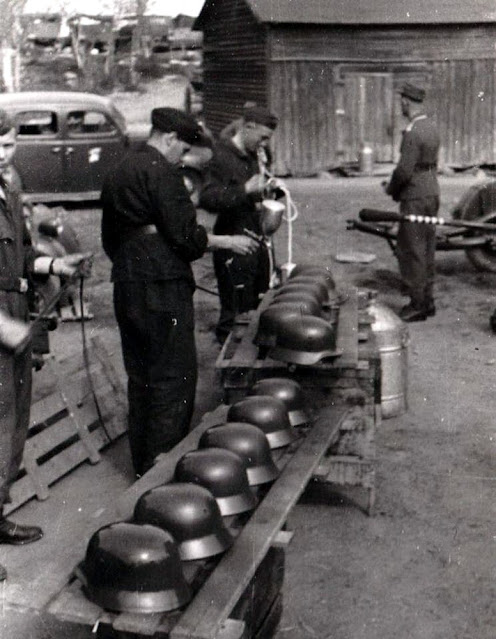
Painting Luftwaffe Helmets

 
From shiney helmets into a Matt finish: nice photo showing a Luftwaffe flak unit (circa 1940/41) painting their helmets to come in line with the 1940 order on helmet paint and decals. The sprayers is wearing HBT reed green Luftwaffe worksuits. It is also a very good photo depicting depot repaints of helmets.

Source :
https://www.facebook.com/LuftwaffeFD/photos/a.114470297207428/314601447194311/

Saturday, June 5, 2021

Bio of Generalmajor z.V. Theodor Ertel


Generalmajor Theodor Ertel

Born: 04 Dec 1874 in Wörth, Rhineland
Died: 13 Apr 1961 in Munich (München)

Promotions:
Unteroffizier (01 Dec 1893); Fähnrich (23 Jan 1894); Sekondeleutnant (05 Mar 1895); umernannt zum Leutnant (01 Jan 1899); Oberleutnant (26 Dec 1900); Hauptmann (25 Aug 1907); Major (30 Nov 1914); Charakter als Oberstleutnant (28 Sep 1919); Charakter als Oberstleutnant a.D. (01 Oct 1933); Oberst a.D. (15 May 1934); Oberst (E) (05 Mar 1935); Oberst z.V. (11 Nov 1938); Generalmajor z.V. (15 Oct 1941)

Career:
Entered Army Service (18 Jul 1893)
Volunteer and Officer-Aspirant in the 2nd Bavarian Foot-Artillery-Regiment (18 Jul 1883-13 Nov 1903)
Detached to Artillery and Engineer School (01 Oct 1896-30 Sep 1898)
Adjutant of the II. Battalion of the 2nd Bavarian Foot-Artillery-Regiment (01 Oct 1898-01 Sep 1900)
Detached to the Bavarian War Academy (01 Oct 1900-30 Sep 1903)
Adjutant of the Bavarian Foot-Artillery-Brigade (13 Nov 1903-25 Aug 1907)
Company-Chief in the 2nd Bavarian Foot-Artillery-Regiment (25 Aug 1907-18 Dec 1910)
Transferred into the Bavarian War Ministry (18 Dec 1910-08 Sep 1914)
Commander of the 6th Bavarian Reserve-Foot-Artillery-Regiment (08 Sep 1914-08 Dec 1915)
Commander of the IV. Battalion of the 1st Bavarian Foot-Artillery-Regiment (08 Dec 1915-20 Mar 1916)
Detached to the Staff of the General Of Foot-Artillery 13 (20 Mar 1916-29 Jul 1916)
Detached to Army-Group Gallwitz (29 Jul 1916-30 Aug 1916)
Detached to the Staff of the Bavarian General Of Foot-Artillery 2 (30 Aug 1916-25 Feb 1917)
Staff-Officer of Artillery with the Staff of the X. Army-Corps (25 Feb 1917-15 Aug 1917)
Detached to 7th Course for Staff-Officers with the Artillery-Survey-School in Wahn (04 Jul 1917-12 Jul 1917)
Detached for use as a Staff-Officer of Artillery with the High-Command of Army-Detachment B (25 Jul 1917-15 Aug 1917)
Artillery-Advisor of Group Vaux and Ornes with the General-Command XI, later V. Reserve-Corps (15 Aug 1917-12 Oct 1917)
Commander of the 2nd Bavarian Reserve-Foot-Artillery-Regiment (12 Oct 1917-18 Jan 1919)
Transferred back into the 2nd Bavarian Foot-Artillery-Regiment (18 Jan 1919-17 Feb 1919)
Commander of the II. Battalion of the 1st Bavarian Foot-Artillery-Regiment (17 Feb 1919-11 Jul 1919)
Retired (11 Jul 1919)
Studies of Law and Political Sciences at the University of Munich (01 Apr 1919-31 Mar 1922)
At the same time, Employed with Inspection South of Reichs Commissaries for Imports & Export Supervision (15 Dec 1919-01 Apr 1922)
Director of the Administration-Department of Exhibition-Contractor Münchener Edelmesse (01 Apr 1922-01 Sep 1923)
Advisor with the Direction of Stock Administration with Military-District-Command VII (01 Sep 1923-01 Oct 1925)
Director of the Equipment-Stock-Administration with Military-District-Command VII (01 Oct 1925-01 Oct 1933)
Employed by the Army (01 Sep 1933); Territorial-Officer (01 Oct 1933); Supplemental-Officer (05 Mar 1935)
With the Staff of Military-District-Command VII (01 Oct 1933-22 Dec 1934)
Detached to Field-Equipment-Administration VII (22 Dec 1934-01 Jan 1935)
Director of Field-Equipment-Administration VII (01 Jan 1935-21 Dec 1937)
At the same time, Director of Army-Field-Equipment-Group 3 (01 Jan 1935-15 Oct 1935)
Retired (31 Dec 1937)
Placed to Disposal (Army) (11 Nov 1938)
Called Up to Field-Equipment-Command VII (22 Sep 1939-01 Oct 1939)
Commander of Field-Equipment-Command VII (01 Oct 1939-10 Jan 1943)
Führer-Reserve, Military-District-Command VII (10 Jan 1943-31 Mar 1943)
Retired (31 Mar 1943)

Awards & Decorations:
Ritterkreuz des königlichen Hausordens von Hohenzollern mit Schwertern (22 Apr 1918)
1914 Eisernes Kreuz I. Klasse
1914 Eisernes Kreuz II. Klasse
Wehrmacht-Dienstauszeichnungen mit Eichenlaub (40 jahre)

Source :
http://www.geocities.ws/orion47.geo/WEHRMACHT/HEER/Generalmajor/ERTEL_THEODOR.html
https://gmic.co.uk/topic/76875-ribbon-bar-long-service-for-40-years/

Bio of Generalmajor z.V. Karl Hausser

Generalmajor Karl Hausser
Born: 11 Feb 1875 in Oberkirchberg, District Ulm
Died: 30 Nov 1943 in Göppingen

Promotions:
Fähnrich (16 Jun 1894); Sekondeleutnant (27 Jan 1895); Oberleutnant (25 Feb 1904); Hauptmann (13 Sep 1911); Major (27 Jan 1918); Oberstleutnant (01 May 1923); Oberst (01 Mar 1928); Generalmajor z.V. (01 Oct 1941)

Career:
Entered Army Service (16 Oct 1893)
Fahnenjunker in the 123rd Grenadier-Regiment (16 Oct 1893-01 Oct 1911)
Company-Chief in the 123rd Grenadier-Regiment (01 Oct 1911-Autumn 1914)
Battalion-Commander in the 123rd Grenadier-Regiment (Autumn 1914-19 Sep 1916)
Staff-Offizer of MG-Troops with Army High Command 4 (19 Sep 1916-10 Dec 1918)
With the Replacement-Battalion of the 123rd Grenadier-Regiment (10 Dec 1918-01 Oct 1919)
With the Staff of II. Battalion of the 26th Reichswehr-Rifle-Regiment (01 Oct 1919-01 Oct 1920)
With the Staff of the 5th Pioneer-Battalion (01 Oct 1920-08 Jul 1921)
Commander III. Battalion of the 13th Infantry-Regiment (08 Jul 1921-01 Feb 1923)
Transferred into the RWM (01 Feb 1923-08 Jan 1927)
Commandant of the Troop-Exercise-Grounds Münsingen (08 Jan 1927-31 Jan 1929)
Retired (31 Jan 1929)
Director of B.B. Ulm and of Training with T.L. Donau (01 Apr 1929-01 Oct 1933)
Entered Army Service as Territorial-Officer (01 Oct 1933); Supplemental-Officer (05 Mar 1935)
Commander of Military-District-Command Ulm (01 Oct 1933-30 Jun 1937)
Retired (30 Jun 1937)
Placed to Disposal (Army) (01 Jul 1938)
Commandant of Troop-Exercise-Grounds Münsingen (24 May 1940-30 Apr 1942)
Führer-Reserve (30 Apr 1942-31 May 1942)
Retired (31 May 1942)

Awards & Decorations:
1914 Eisernes Kreuz II. und I.Klasse
Verwundetenabzeichen 1918 in Schwarz
Ritterkreuz des Königlicher Preußischer Hausorden von Hohenzollern mit Schwertern
Wehrmacht-Dienstauszeichnung mit Eichenlaub (40 jahre)

Source :
http://www.geocities.ws/orion47.geo/WEHRMACHT/HEER/Generalmajor/HAUSSER_KARL.html

Friday, January 1, 2021

Ernst-August Köstring with a Traditional Guitar


General der Kavallerie Ernst-August Köstring holding a traditional Eastern people's guitar. It looks likes a Georgian Panduri. Most likely he was visiting a Georgian-manned unit, in his capacity as "General Officer attached to Army Group A for Caucasian Questions" (from 1942 on).


Source :
https://forum.axishistory.com/viewtopic.php?f=51&t=254527&p=2312393#p2312393

Thursday, December 24, 2020

Skijäger Brigade at Pripet region

Skijäger aiming his brand new MP.43/1 (Stg.44) assault rifle, with his LW gravity knife dangling from his belt. Note the protective rubber cap on the muzzle. The Fallschirmjäger gravity knife is not a standard issue for Skijäger, but  it was issued in significant numbers to them. The picture itself was taken in January 1944 at Pripet (Bug) region.


1. Skijäger Brigade at Pripet region, January/ February 1944. The unit had top priority in the distribution of MP 43 (later Stg.44). In January 1,553 assault rifles out of 5,400 were issued to the brigade. Each company fielded a shock-platoon armed with 30 of these revolutionary weapons.
LW gravity knives (Jäger in the middle) were standard issue just like Fallschirmjäger gas masks canvas containers were.


Carrying a wounded comrade. Skijäger Brigade in the Pripet region, January/ February 1944. Note the white-washed MP.43 magazine pouch and the man carrying the wounded which probably wears a StuG-Jacke.. Given the casual face of the 'wounded' man it is possible that this is just all for posing to the PK-Man. Note the right most man seems to be carrying a camera box himself. He's also armed with a G43. None of them seem to be wearing Bergschuhe these troops often were issued with.


Taking casualties even when the reporters are there. Skijäger Brigade in the Pripet area,March 1944. This is not the same chap that was carried in a previous photo, even though it's from the same film roll and Kriegsberichter. Looks like here is something real going on. Two on them are wearing Windblusen. It is a very good piece of over clothing. Nowadays we would retrieve the hand grenades and remove the web gear before giving assistance!


1 Skijäger Birgade in the Pripet marshes, February 1944.

1. Skijäger-Brigade in the Bug area (Pripet), February-March 1944. The MP 43 assault rifle is really white and it does show how well it blends in with the snowy background. All is in white-washed camo, with only the rifle sling and the shoes have not been painted.

1. Skijäger-Brigade patrol armed with MP 43/1, led by an officer. Bug area (Pripet) February-March 1944. The leading Skijäger has his LW gravity knife dangling at its belt. These men were clever enough to adapt their camouflage to their surroundings (wearing a white top would have outlined them against the forest of dark tree trunks behind!). The men were well supplied with MP 43s. Which is an excellent weapon for that terrain. The sub machine gun look identical to the MP44 but there are a few slight differences, mainly the muzzle nut is longer then the one used on the MP44.


Source :
ECPAD Archives, courtesy of Blanluet Christophe
https://www.facebook.com/groups/2360048380929060/

Wednesday, December 23, 2020

1. Skijäger-Brigade Patrol


1. Skijäger-Brigade patrol armed with MP 43/1, led by an officer. Bug area (Pripet) February-March 1944. The leading Skijäger has his LW gravity knife dangling at its belt. These men were clever enough to adapt their camouflage to their surroundings (wearing a white top would have outlined them against the forest of dark tree trunks behind!). The men were well supplied with MP 43s. Which is an excellent weapon for that terrain. The sub machine gun look identical to the MP44 but there are a few slight differences, mainly the muzzle nut is longer then the one used on the MP44.


Source :
ECPAD Archives, courtesy of Blanluet Christophe
https://www.facebook.com/groups/2360048380929060/permalink/2740822902851604/?__cft__[0]=AZWuNFyXPGqbnTji8wcpcT7RyNUsAwMnU8qEFBc0ptTZpYietWzLFlxotJ_jGZ8kwaaYwYHv9c1_vRXv_G1MdNMxZtKq3bsS8-OoIw93gltw2QDdIWfCPm0x7b2m5iGy9JsFtGeF1COK79SuXN2qCq6I&__tn__=%2CO%2CP-R

Friday, December 18, 2020

Bio of Generalmajor Felix Jacobi


Generalmajor Felix Jacobi
Born: 31 Mar 1880 in Tübingen
Died: 22 Jan 1960 in Bad Liebenzell

Promotions:
Fähnrich (22 Mar 1899); Leutnant (18 Aug 1900); Oberleutnant (27 Jan 1910); Hauptmann (20 May 1914); Major (04 Feb 1923); Oberstleutnant (01 Jun 1928); Charakter als Oberst (31 Mar 1930); Oberst (01 Aug 1935); Generalmajor (01 Dec 1941)

Career:
Entered Army Service (20 Mar 1899)
Fähnrich in the 126th Infantry-Regiment (20 Mar 1899-13 Sep 1911)
Transferred into the 3rd Airship-Battalion (13 Sep 1911-20 May 1914)
Company-Chief in the 4th Airship-Battalion (20 May 1914-01 Aug 1914)
Commandant of Airships Z 7, Z 34 and Z 1 then Commander of the 30th Airship-Battalion (01 Aug 1914-11 Oct 1919)
Transferred into the 5th Artillery-Regiment (11 Oct 1919-21 Dec 1922)
With the Staff of the 5th Division (21 Dec 1922-16 Mar 1925)
Commander of the 3rd Motor-Transport-Battalion (16 Mar 1925-31 Jan 1930)
Retired (31 Jan 1930)
Employed by the Army (01 Jul 1930)
With the Command-Office Ulm (01 Jul 1930-01 Oct 1933)
Entered Army Service as a Territorial-Officer (01 Oct 1933); Supplemental-Officer (05 Mar 1935); Active-Officer (01 Jun 1941)
With the Wehrmacht-Inspection Ulm (01 Oct 1933-06 Oct 1936)
Commander of Military-District-Command Darmstadt (06 Oct 1936-25 May 1940)
Field-Commandant 548 (25 May 1940-18 Jan 1941)
Field-Commandant 503 (18 Jan 1941-04 Apr 1943)
Führer-Reserve (04 Apr 1943-31 Mar 1944)
Retired (31 Mar 1944)

Awards & Decorations:
Erinnerungsabzeichen für Besatzungen der Marine-Luftschiffe


Source :
http://www.geocities.ws/orion47.geo/WEHRMACHT/HEER/Generalmajor2/JACOBI_FELIX.html
https://www.leo-bw.de/en_US/web/guest/detail-gis/-/Detail/details/DOKUMENT/labw_findmittel_06/labw-1-327227/Jacobi+Felix+Bild+1

Thursday, December 17, 2020

German Funker (Radioman) in the Eastern Front


Ostfront. No date. He is wearing a Funktasche (telegraphist leather pouch), specially the Brustmikrofon 33 pouch. This Funker (radioman) is also wearing a Mückennetz, mosquito net, over his helmet. Note how the left Schulterklappe has torn loose!


Light casualty


Source :
ECPAD Archives, courtesy of Blanluet Christophe
https://www.facebook.com/photo/?fbid=10158690381733308&set=gm.2640673829533179
https://www.facebook.com/photo/?fbid=10158383440368308&set=gm.2554634734803756

Sunday, July 5, 2020

Waffen-SS Patarooper

Portrait of SS Paratrooper with the rank of Oberscharführer

Source :
https://germanmilitaryrelics.com/index.php/papers-books-photos/german-elite-waffen-ss-portrait-wwii-elite-waffen-ss-portrait-2-wk.html

Friday, May 8, 2020

Newly Wed Couple with Gas Car

Düsseldorf, Germany during World War II. Newly wed couple with their strange looking car. The vehicle is a Mercedes-Benz 170V converted for pressurised gas.


Sumber :
https://www.flickr.com/photos/123629787@N04/
https://forum.axishistory.com/viewtopic.php?f=47&t=73232&start=11280

Sunday, February 9, 2020

Landespolizei Training

Young artillerymen training with a 7,5 cm leichtes Infanteriegeschütz 18 (7,5 cm le.IG 18), autumn of 1936. This light artillery piece was introduced in 1932, intended to provide artillery support on regimental level. It was crewed by five, and could fire a 6 kg grenade up to 3.5 kilometers. The uniforms of the gun crew are from Landespolizei. They look like police uniforms, with their dark, two-button cuffs and many front buttons. The boots seems to be police issue, too. The Army-style national eagle over the breast pocket wasn’t a feature on police uniforms, even if there were exceptions. The M1918 Stahlhelm doesn’t add to the mystery, though, as the newly introduced M35 helmet hadn’t been produced in sufficient numbers by then. The boots are probably the three-buckle Army boots used before the traditional jackboot was reintroduced again. The buckled boots had lacing, but there were issues with them leaking, so the older style was preferred.


Source :
Photo collection Björn Hellqvist
https://ww2inphotos.wordpress.com/2017/07/24/mystery-uniform/

Saturday, May 18, 2019

SS-Obersturmführer Rolf Schackert from Legion Freies Indien

Studio photo of SS-Obersturmführer Rolf Schackert (Chef Stabskompanie / Indische Freiwilligen Legion der Waffen-SS), who wore his new SS uniform in lieu of the old Heer uniform. Note the use of a plain black collar on the left, which is intentionally left blank while awaiting for the arrival of the "Tiger's head" kragenspiegel, which is the official insignia of the this SS Regiment consisting of Indian volunteers. In Schackert's arm we can also see the shield of "Freies Indien" (Free India), which has been used by members of the Indian Legion from the time they were in the Heer. Like all other non-Reichsdeutsche (German descent within the Reich's territory) members of the Waffen-SS, Indian members of the Freiwilligen Legion der Waffen-SS were forbidden to wear "double flash" SS symbols on their collars. Instead, they are allowed to display unit symbols on their collars and arms. This photo itself is a private collection of Christopher Ailsby, author of the book "Waffen-SS: Hitler's Elite in Photographs"


Source

Saturday, March 3, 2018

SS Soldiers in France

German soldier from SS-Standarte "Der Führer" / SS-Division-Verfügungstruppe (motorisiert) in France in 1940. He wore a stahlhelm cover and a camouflage jacket of the Platanenmuster type. Shortly after the German military campaign in France, collar numbers were withdrawn from circulation for safety reasons, leaving only SS runes. This photo is taken from the book "Waffen-SS Im Westen: Ein Bericht In Bildern" by SS-Kriegsberichter Friedrich Zschäckel, published in 1941. The original caption reads: "Das Geschicht der Waffen-SS" (Face of the Waffen-SS).


Source :
"Waffen-SS Im Westen: Ein Bericht In Bildern" by Friedrich Zschäckel

Friday, January 15, 2016

SS-Untersturmführer Havvo Lübbe of the Leibstandarte Division in 1942

Portrait of SS-Untersturmführer Havvo Lübbe of the Leibstandarte Division, circa 1942. He would later served in 12. SS-Panzer-Division "Hitlerjugend". From this studio portrait we can identify his decorations: Ribbon of Eisernes Kreuz II.Klasse (Iron Cross 1st Class); ribbon of Medaille "Winterschlacht im Osten 1941/42" (Ostmedaille); Verwundetenabzeichen in Schwarz (Wound's Badge in Black); Infanterie-Sturmabzeichen in Bronze (Infantry Assault Badge in Bronze); and Deutsches Sportabzeichen (German Sports Badge). Note the Heeres adler in his visor cap and sleeve!

Thursday, January 14, 2016

Flemish SS Recruits in Light Mortar Training

Flemish recruits undergoing training in the use of a light mortar. They are devoid of shoulder straps and collar patches, presumably because these recruits have not yet passed out as trained members of the Flemish SS Legion. The two-man mortar team is protected by a third man, who armed with a rifle, is there to give covering fire if required.

Thursday, October 15, 2015

U-Boat Type IXD2 Back to the Port from a Successful Mission

A large, long-distance boat of Type IXD2, probably U-178 or U-181, coming into port with the attack periscope raised to act as a flagpole for a mass of success pennants. The unusual patterns on the side of the hull are shadows from the reception party on the pier.