Showing posts with label 1940. Show all posts

Thursday, January 22, 2026

Die Deutsche Wochenschau (German Weekly News) Nr. 534 - 27 November 1940


Die Deutsche Wochenschau is the title of the unified newsreel series released in the cinemas of Nazi Germany from June 1940 until the end of World War II, with the final edition issued on 22 March 1945. The co-ordinated newsreel production was set up as a vital instrument for the mass distribution of Nazi propaganda at war.

In this Die Deutsche Wochenschau video:

00:21 - Earthquake in Bucharest (1940 Vrancea earthquake), Romania, 10 November 1940.
Occurred on Sunday, 10 November 1940, in Romania, at 03;39 (local time), when the majority of the population was at home. This earthquake registered a magnitude of 7.7 on the moment magnitude scale. Rescue operations at night after the earthquake. 267 people were killed in the collapse of Carlton Bloc, the tallest building in the city of Bucharest at the time. King Michael inspecting the earthquake damage.

01:22-01:55 - Duche visits armaments factories, Terni, Italy, 1940.
Benito Mussolini visits armaments factories and factory's post-war house. 

01:56-03:32 - Italian Front, North Africa, Sidi El Barrani, Egypt, 1940.
Soldiers building roads to the frontline for better logistics. New telegraph lines are laid by communications unit. Military vehicles are being repaired in a motor vehicle workshop near Sidi El Barrani, including tankettes (Carro Veloce CV 33) and trucks. Advanced units are supplied with drinking water. Anti-aircraft guns (Breda Model 35/2cm) and 8.8 cm heavy AA-gun fire at attacking British aircrafts. 

03:33-05:39 - Resettlement of the "Bessarabian Germans", Bessarabia, Soviet Union, 1940.
When Bessarabia was occupied by the Soviet Union in June 1940 as a result of the Hitler-Stalin Pact, almost all the “ethnic Germans” living there were resettled in the German Reich. The resettlers are being transported and cared for by the SS, the National Socialist Motor Corps (NSKK), the National Socialist People's Welfare (NSV), and the German Red Cross (DRK). 

05:40-07:15 - Meeting at the Berghof on the Obersalzberg, German Reich, 1940.
Italian Foreign Minister Count Galeazzo Ciano and Spanish Foreign Minister Ramon Serrano Suñer arrives at the Berghof and were greeted by Reich Foreign Minister Joachim von Ribbentrop.

07:16-10:06 - Hungary's accession to the Tripartite Pact, Vienna, November 20, 1940, 1940.
The Hungarian delegation: Prime Minister Pál Teleki and Foreign Minister István Csáky. Ribbentrop, Count Ciano, Kuruso, and Csáky at the signing of the treaty. 

10:07-12:24 - Romania's accession to the Tripartite Pact, Berlin, November 23, 1940, 1940.
Prime Minister Ion Antonescu arrives in Berlin and is greeted by Ribbentrop. Ribbentrop, Kurusu, Buti, and Antonescu at the signing of the treaty.

12:25-13:12 - Slovakia's accession to the Tripartite Pact, Berlin, November 24, 1940.
Slovak Prime Minister Dr. Vojtech Tuka arrives in the New Reich Chancellery. Ribbentrop, Ambassador Kurusu, Ambassador Buti, Foreign Minister Sturdza, and Dr. Tuka at the signing of the treaty.

13:13-13:59 - "Victory in the West" exhibition, Vienna, 1940.
Herman Göring inspects the exhibition in which many different tanks are included (Somua S-35, Matilda II, Panzer IV, and Renault FT-17), aircrafts and artillery. 

14:00-17:27 - "Sprottebruch" Reich Labor Service camp, German Reich, 1940.
Men get dressed and walk in groups to morning exercises. Bicycle detachment sets off to work. 

17:28-18:45 - Cleanup work between the West Wall and the Maginot Line, France, 1940.
Bunkers are overhauled, cleaned and closed. French prisoners of war removing wire barriers.

18:46-20:55 - Logistics, Norway, 1940.
Food and material supplies for the German troops in Norway. Soldiers build winter quarters and reinforce wooden barracks. A group of Lapps with reindeer visits the German soldiers. 

20:56-22:18 - Surveillance flight, Norwegian coast, 1940.
Messerschmitt Bf-110 aircraft on surveillance flight over fjords and the coastal area.

22:19-23:06 - Iron Cross awards, English Channel coast, France, 1940.
Reich Marshal Hermann Göring awards the Iron Cross to individual soldiers.

23:07-24:39 - Luftwaffe logistics, German Reich, 1940.
Fuel resupply for the fighting German Air Forces against England. Fuel is transferred to a tanker and into the airport's underground tanks.

24:40-26:19 - Night air raid on Coventry, Great Britain, 1940.
Retaliation air raid for the British attacks on non-military targets in Munich. Heinkel He-111 dropping bombs over Coventry. Over 500,00kg bombs were dropped in a single night.

26:20-30:59 - U-99 submarine enters the U-boot shipyard in Lorient, France/Atlantic Ocean, 1940.
Lieutenant Commander Otto Kretschmer - commander of the "U 99" (Type VII B) submarine, sank a total of over 200,000 gross register tons. Footage of the U-boot in action by a war correspondent. Führer awarded Otto Kretschmer the Oak Leaves to the Knight's Cross on November 4, 1940.


Source :
https://archive.org/details/die-deutsche-wochenschau-berita-mingguan-jerman-no.-534-27-november-1940-teks-indonesia
https://digitaler-lesesaal.bundesarchiv.de/en/video/7118
https://www.youtube.com/watch?v=m9lotOjobXA

Tuesday, January 20, 2026

Die Deutsche Wochenschau (German Weekly News) Nr. 532 - 13 November 1940


Die Deutsche Wochenschau is the title of the unified newsreel series released in the cinemas of Nazi Germany from June 1940 until the end of World War II, with the final edition issued on 22 March 1945. The co-ordinated newsreel production was set up as a vital instrument for the mass distribution of Nazi propaganda at war.

In this Die Deutsche Wochenschau video:

00:21-01:06 - Architecture exhibition in Belgrade, Serbia, 1940.
Opening of German architecture exhibition in Belgrade Exhibition Center. Prince Regent Paul and Princess Olga get out of the car, and visit the exhibition. Inside, they are inspecring works of German architects: models of most impressive buildings of the new Germany. 

01:07-01:45 - Italian occupation of Albania, 1940. 
Scenes shows how Albania's infrastructure is developing since Italian occupation. Construction of modern road networks, and bridges. 

01:46-02:38 - Mussolini inspects Italian 8th Army, Italy, 1940.
Lined up Italian soldiers, artillery, military vehicles and equipment on the roll call during inspection of the Duce. 

02:39-04:48 - Celebration of Remembrance Day for the fallen fighters, Munich, German Reich, 1940.
On November 9, 1923, the NSDAP led by Adolf Hitler attempted a coup in Munich, known as the Beer Hall Putsch. The failed coup was aimed at overthrowing the Bavarian government and ultimately the German federal government. The Hitler's Deputy, Rufolf Hess greets the relatives of the dead. Ceremony of paying tribute to the fallen, soldiers laying wreaths on the memorials.

04:49-05:24 - Parade of local detachments of Hitler Youth, Protectorate of Bohemia and Moravia, Prague, 1940.
German Youth Leader Arthur Axmann in Prague inspects the parade of Hitler Youth from Protectorate of Bohemia and Moravia. The Protectorate of Bohemia and Moravia was a partially-annexed territory of Nazi Germany that was established on 16 March 1939 after the German occupation of the Czech lands. Also shown Generalmajor Ulrich von Waldow and Generalmajor Georg von Prondzynski.
 
05:25-07:15 - Joseph Goebbels visit to Prague, Protectorate of Bohemia and Moravia, Prague, 1940.
Goebbels is greeted by Reich Protector of Bohemia and Moravia Konstantin von Neurath, Gauleiter Henlein and the Protectorate Secretary of State Karl Hermann Frank. In Černín Palace, Joseph Goebbels adresses German cultural figures of the Protectorate and thank them for their work. Goebbels gives a speech to the German community in Prague.

07:16-08:42 - Construction of military training grounds, German Reich, 1940.
Construction of military training grounds required to relocate local farmers in some areas. The Wehrmacht institutions assisted farmers in establishing new farms in the Emsland region. Scenes show building houses for peasants evicted from the territory of the future training ground. 

08:43-12:22 - Military maneuvers of Wehrmacht, German Reich, 1940.
Wehrmacht combat readiness is constantly increased through diverse exercises. Scenes show training of German engineers in crossing the river maneuver, with the use of combined arms. Soldiers land on the opposite bank, and build a river crossing for the heavy equipment to. 

12:23-14:00 - Arrival of Italian pilots in Flanders, Belgium, 1940.
Italian pilots arrive in Flanders to conducts attacks against England together with german pilots. Unloading troops, equipment, vehicles and fuel on the station. The commander of the Luftwaffe inspects a units that have arrived in Germany. 

14:01-17:06 - Battle of Britain, Channel Coast, France, 1940.
Luftwaffe ground crews prepare fighter planes before combat patrol. Oxegen for the breathing apparatus is refilled. Lieutenant Colonel Werner Mölders prepares for the combat patrol and boards his BF-109 fighter plane. Formation of Bf-109 fighters during combat patrol along Channel Coast. German fighters in the air combat with British Spitfire plane.

17:07-21:35 - Kriegsmarine operations against England, 1940.
The German submarine on the combat patrol against England. German warship's boarding team capture a British freighter, and take it's crew on board. Then the freighter is being sunk by explosives. Another vessel is being spotted and taken under fire, in result it being sunk. Scene show captured English on board of German warship. 


Source :
https://archive.org/details/die-deutsche-wochenschau-berita-mingguan-jerman-no.-532-13-november-1940-teks-indonesia
https://digitaler-lesesaal.bundesarchiv.de/en/video/7116/684328
https://www.youtube.com/watch?v=zUU-LNi7FBc

Sunday, December 28, 2025

Die Deutsche Wochenschau (German Weekly News) Nr. 531 - 6 November 1940


Die Deutsche Wochenschau is the title of the unified newsreel series released in the cinemas of Nazi Germany from June 1940 until the end of World War II, with the final edition issued on 22 March 1945. The co-ordinated newsreel production was set up as a vital instrument for the mass distribution of Nazi propaganda at war.

In this Die Deutsche Wochenschau video:

It shows a large variety of different footage, including harvest in Germany, building of new Autobahn sections, a visit of SA-chief Viktor Lutze in occupied Poland, an exercise of German troops in occupied France and German fighter and bomber squadrons, including a bombing raid of Heinkel He-111 bombers on England, among other things. This issue also shows footage of Italian troops in North Africa and from Japanese bombers allegedly bombing the Burma Strait.

Remarks :

02:44 Construction of the bridge in Kasern started in 1938, but was stopped due to the war in 1941, and the bridge was only finished in 1950. It was refurbished between 2009 and 2012. 

02:56 The German Labor Front, created in May 1933, was the national labor organization in Nazi Germany after the ban of independent trade unions. All working Germans had to be a member of the Labor Front, and it was a tool of the Nazi government to control the workers and to expose them to Nazi propaganda. The Labor Front also employed people, as shown here, most of these people were unemployed before and drafted into construction work.

03:51 KdF is an abbreviation standing for Kraft durch Freude (Strength through Joy) and was a Nazi leisure organization, part of the Labor Front. Its main goal was to organize holidays for workers and to improve their working environment, but like all Nazi organization, its main goal was to promote Nazism among its members.

04:30 On Spitzerberg mountain, a 302m high mountain in Lower Austria, a simple airstrip was created for gliders already in 1929, and in 1936, a hangar and buildings were added. In late 1939, a proper flying school for gliders was constructed, this was inaugurated on October 19th, 1940. It is still used as a flying school today.

04:34 Hugo Jury (1887-1945) was an Austrian doctor and Nazi politician. He studied Medicine between 1905 and 1911, and joined the Austrian Nazi Party in February 1931, where he was a local councilmember for the NSDAP. After the Nazi Party was banned in Austria in June 1933, he continued working for it illegally, for which he was arrested several times. After the German annexation of Austria, he became Gauleiter for Niederdonau and served in various other high-ranking positions. He killed himself after Germanys surrender on the night of May 8th/9th 1945. 

04:42 Claus von Bohlen (1910-1940) was a German fighter pilot during WWII. He was part of the 2nd Group of JG 54, and on January 10th, 1940, he tested a new oxygen mask, which failed and caused him to become unconscious, crashing his plane and dying. 

04:47 I was sadly not able to find any information about who Curt Opolski or Emmerich Sikorka were.

05:33 Viktor Lutze (1890-1943) was an SA-General and Nazi politician. He initially worked as a post clerk, before joining the Army in 1912 and fighting in WWI, being wounded four times. He left the Army as an officer in 1919 and was a co-owner of a small foundry from 1921 to 1925. In 1922, he joined the NSDAP and in 1923 the SA; he became the regional SA-Leader for the Ruhr Area in 1926. In 1931, he became SA-Leader for North Germany. After the Röhm purge in July 1934, Lutze became new leader of the SA, which had lost a lot of power by then and was basically little more than an organization providing pre-military training for its member. He was responsible for the terror against Jewish people and business in the November pogroms in 1938. Lutze had a serious car crash on May 1st, 1943, and died of the wounds sustained in the accident the next day.

05:38 The Marienburg Castle in Western Prussia is a 13th century castle built by the Teutonic Knights. When it was finished in 1406, it was the world’s largest brick castle. It was heavily damaged in WWII but was restored from 1962 to 2016 and is now a UNESCO World Heritage Site. 

05:50 Joachim Meyer-Quade (1897-1939) was a German politician and SA-General. He fought in WWI from January 1915, but became a French POW in November 1916. Released in January 1920, he worked as a farmer and farm inspector afterwards. He joined the NSDAP in June 1925 and the SA in July 1927, becoming leader of the SA-Group Schleswig in 1932. After the Nazis took power, he became Police Commissioner in Kiel, and led the SA-Group Nordmark since September 1935. In 1939, he took part in the invasion of Poland as a Lieutenant and infantry company commander, but was killed during fighting on September 10th, 1939. He was one of the first higher ranking Nazis to be killed in combat in WWII, and several units and places were named in his honor.

05:51 The Polish city of Lodz was re-named Litzmannstadt in April 1940, in honor of the German General and NSDAP politician Karl Litzmann (1850-1936).

06:16 I believe that “Freedom Day” refers to the invasion of Poland in Nazi Propaganda, but I’m not 100% sure of that. 

06:19 The SA-Standard 6 was given the honorary name “Hans von Manteuffel”, in remembrance of Hans von Manteuffel-Szoege (1894-1919) a Baltic-German officer who died as leader of the Baltic Territorial Army in fighting against the Soviet Russia Army in Riga in 1919. 

06:50 The General Government was the name of the occupied Polish territories that were not incorporated into Germany. 

06:57 Hans Frank (1900-1946) as a German Nazi politician. He already joined the DAP, the predecessor of the NSDAP in 1919. He studied law and economy from 1919 to 1923, achieving his PhD in 1924. He joined the SA in September 1923, and the NSDAP in October 1923, he took part in the failed coup attempt in November that year. He continued his career in the NSDAP, becoming Hitlers personal lawyer, defending him in over 40 trials, becoming a close friend of Hitler. After the Nazis took power, he became Justice Minister in Bavaria from March 1933 to December 1934, and he founded the Academy of German Law, an important tool in giving a legal basis to Nazi terror and atrocities. His most famous office was that of General Governor in Poland, which he held from October 1939 to the end of the war.  Nicknamed “The Butcher of Poland”, he was responsible for the killing and forced labor of millions of Polish civilians, the suppression of Polish culture and the looting and stealing of valuable goods. He fled in January 1945 from the advancing Red Army but was arrested in May in Bavaria and tried in the Nuremberg trials. He was convicted to death and executed on October 16th, 1946.

07:20 The Main Square in Krakow was renamed “Adolf-Hitler-Square” during the German occupation.

08:10 To replace male personnel, over half a million women were employed by the Wehrmacht during WWII. Especially in the early war most of them served, as shown here, as telephone or telegraph operators, but from 1943 onwards, they were also used to operate AA-searchlights, listening devices and sometimes even on the guns themselves. 

08:52 The Lightning Bolt was a symbol of the German Signal Corps. Because it was printed on the tie and or the sleeve of the uniforms of these female auxiliars, they were nicknamed “Lighting Girls”.

10:06 The vehicle on the right in this shot is a Panhard 178, a French reconnaissance armored car produced between February 1937 and April 1940. It had a 25mm main gun; 729 vehicle built, with a further 414 B-versions built after WWII. As for the vehicle on the left, I am not sure what exactly this is, it looks like an early, 1920s style armored car.

10:10 This is a British Matilda II infantry tank. Designed in 1937, 2,987 were built between 1937 and 1943. It had strong frontal armor, up to 78mm, and was equipped with a 40mm gun, but only had a maximum speed of 24kmh on road and 14kmh off-road. A few dozens of these were used by British troops during the Invasion of France, and subsequentially some of them were captured by the Germans. 

10:15 This is a Renault UE Chenillette, a smal tracked armored carrier and artillery mover, built between 1932 and March 1941. Around 5,100 were built, and the Germans captured around 3,000 of them, using them in various roles, as tractor, but also putting guns or rocket artillery launchers on them. 

10:18 This tank is a Somua S 35, medium tank, armed with a 47mm gun and up to 47mm of armor. Around 440 were built between 1935 and June 1940, many of these were later re-used by the Germans.

14:08 Herms Niel (1888-1954) was a German composer and one of the most influential composer of military music during the Nazi era. He trained as a musician and joined the Guards Regiment in Potsdam as a Trombonist in 1906, staying in the army until 1918. After WWI, he worked as a tax officer until 1927, when he co-founded an Orchestra. He joined the Nazi party in May 1933 and became the conductor of the Orchestra of the Reich Labor Service. During WWII, he composed many marching songs which were widely distributed by the regime.  He was made a Professor in April 1941 by Hitler. 

14:55 This is referring to a small Italian offensive into Egypt in early September 1940, where Italian forces captured the city of Sollun on September 13th and the important port of Sidi Barrani on September 16th, 1940.  These cities were soon recaptured during the British Operation Compass in December 1940.

16:16 This plane is a Mitsubishi G3M medium bomber. The G3M was introduced in 1935 and produced until 1943, with 1,048 planes made. The G3M, much like its predecessor, the more well-known G4M, was designed as a long range bomber, and in August 1937, a group of G3M, coming from Taiwan, bombed Shanghai- a distance of over 2000km. G3M also took part in the sinking of British battleships HMS Prince of Wales and Repulse, and the sinking of heavy American cruiser USS Chicago in January 1943. The focus on range meant that the G3M had no protective armor and was thus an easy target for Allied fighters. It was used as bomber, torpedo bomber and also transport plane. This particular plane is marked “報國 -339 (興亜號)”, and planes marked with “報國 (Hokoku, literally “Service to the Fatherland)“ were planes donated by indivuals and private companies to the Imperial Japanese Navy. This was a program set up in the 1930s, where companies could “buy” a plane for the Japanese Army or Navy.  This particular plane was donated by Tairiku Shinpo, a Shanghai-based Japanese Newspaper, in October 1938.  

16:27 The Burma Road, a road in Burma used to supply China during the Sino-Japanese war, was indeed closed by the British in April or July 1940 (sources vary) due to Japanese pressure but was reopened in October 1940. However, I couldn’t find any information that the Japanese actually bombed the road, at least not on British territory. They probably bombed it in Chinese territory, as they did regularly during the war. 


17:43 Joachim Schepke (1912-1941) was a German U-Boat commander. He joined the German Navy in April 1930, transferring to the U-Boat force in October 1935, and becoming commander of the U-Boat U-3 when the war broke out. In May 1940, he took over command of U-100. He was portrayed in Nazi propaganda as a successful U-Boat commander, and a book written and illustrated by him in 1940 became a best-seller, he held a speech in berlin in February 1941 in front of thousands of school children about the U-Boat war. On his sixth mission with U-100 on March 17th, 1941, his boat was damaged by depth charges from British destroyers and then rammed and sunk by one. Schepke got trapped between the periscope and the bridge and died, only 6 of his crew survived. His death made public by a speech of Winston Churchill in British parliament. In his career, Schepke destroyed 36 ships with 155,882 tons and damaged four more, despite German records giving a total number of 233,971 tons. 

17:53 Günther Prien (1908-1941) was a German Navy U-Boat commander. He got his captains patent in 1931, but was unable to find a job, out of anger for not finding a job, he joined the NSDAP in 1931. In January 1933, he joined the German Navy, and in 1935, switched to the U-Boat force. Initially serving as an officer on U-26, in December 1938, he was made commander of U-47. His most famous mission was the attack on Scapa Flow. This was basically a suicide attack, as Scapa Flow, a British Navy base, was heavily secured, and due to strong currents, couldn’t be entered submerged. But Prien managed to successfully enter and sink the British battleship HMS Royal Oak. He was awarded the Knights Cross for that and was stylized a Hero by the NS-Propaganda. Prien was most likely killed on the night from 7th to 8th March 1941, when his boat was sunk by British depth charges. His death was made public in late May 1941, and had a negative impact on German morale. In total, Prien sunk 32 ships with 211,393 tons.

18:10 Otto Kretschmer (1912-1998) was a German Navy U-Boat commander. He joined the Navy in April 1930 and was transferred to the U-Boat force in January 1936; he became commander of U-23. In April 1940 he took over U-99. During his final mission, in the early morning of March 17th, 1940, he was attacked by British destroyers and had to give up. He was taken prisoner and sent to a POW camp in Canada in 1942, where he stayed until he was released in 1947. He joined the post-war German Navy in 1957, retiring as Admiral in 1970. Despite his rather short career, he was the most successful German U-Boat commander, sinking 47 ships with 272,282 tons and damaging five more with 37,965 tons.

18:47 Helmut Wick (1915-1940) was a German fighter ace during WWII. He did his mandatory service in the RAD in January 1936, and joined the Air Force in April 1936, finishing Flying School as a Lieutenant in January 1939. Wick fought, as part of JG2 “Richthofen”,  in Poland and over the Western Border, where he achieved his first kill, a French Curtiss Hawk 75, on November 22nd, 1939. He was awarded the Knights Cross on August 29th, 1940, after his 25th kill, and on October 8th, after 41 kills, the Oak Leaves. He was promoted to Major and made commodore of JG2, but with only 25 years, he proved far too young to lead an entire squadron, which led to bad morale among his men. On November 28th, he attacked with his group a British RAF unit. During this dogfight, he achieved his 56th kill, but was shot down and killed. Wick was made a hero by NS propaganda and described as the ideal young German pilot.

18:51 The Fighter Wing 2 “Richthofen” was a German fighter wing, set up in May 1939 and named after the famous WWI fighter ace “Manfred von Richthofen”. It used both the Bf-109 and later the Fw-190 fighters. Initially stationed on the German border in 1939, it took part in the invasion of Belgium and France and was then stationed on the English Channel until September 1944 (although some groups were used in North Africa) and afterwards on the Western Front, where it took part in the Ardennes Offensive. JG2 destroyed around 2,700 enemy planes and lost around 700 pilots during the war. 

19:23 The Heavy Fighter WING ZG 26 “Horst Wessel” was a German Air Force unit during WWII, set up in May 1939 and named after the SA officer Horst Wessel (1907-1930) who was killed by communists and turned into a Nazi martyr. The unit was equipped with heavy Bf-110 fighter planes, later also Me-410, and used during the Invasion of France, on the Eastern Front, over Africa and in the Mediterranean. The unit was reorganized in September 1944 to a regular fighter wing, equipped with Bf-109. 

19:43 Oswald Boelcke (1891-1916) was a German WWI flying ace and one of the first pilots to lay down tactical ground rules for pilots. His book about air combat, Dicta Boelcke, still forms the basis for modern air combat tactic manuals. Boelcke initially joined the German Army as a signal officer in 1911, later joining the newly formed Flying Corps in May 1914. He achieved his first kill in September 1915, and already in January 1916, after his eight kill, he was achieved the Pour le Merite, the highest German war medal at that time, by Emperor Wilhelm personally. Boelcke was known to be a good-hearted man, in August 1915, he jumped into a canal to save the life of a French boy who was drowning. After Max Immelmann, another famous German WWI fighter pilot, died in a crash in June 1916, Boelcke was banned from flying, as his knowledge about aerial combat was deemed too valuable. In August 1916, he became commander of the newly formed Fighter Wing 2, for which he personally picked his pilots. He returned to active flying in September 1916. In October 1916, during a dogfight, his plane touched another German plane, and Boelcke lost control and died. In total, Boelcke shot down 40 enemy planes during WWI. He was greatly honored, and many barracks and units were named after him. Even nowadays, the 31st Tactical Fighter Wing of the modern day German Air Force is named “Boelcke” after him.

19:58 The Bombing Wing 27 “Boelcke” was one of two units of the German Air Force during WWII named after Boelcke, the other being Bomber Wing 154. Bomber Wing 27 was raised in May 1939, equipped with Heinkel He-111 bombers. It took part in the Invasion of Poland, Battle of Britain and the Invasion of the Soviet Union, usually flying tactical attacks on airfields, ports and military installations. But it also took part on attacks on civilian targets in England, such as the infamous Bombing of Coventry in November 1940. In November 1944, the unit was re-equipped with Bf109 and FW 190 fighter planes, and it became a regular fighter wing. It was active until German surrender in May 1945. 

20:03 Boelcke was buried in Dessau, and a memorial was erected on his grave in 1921, which still stands today.

20:36 These planes are Heinkel He-111 medium bombers, the standard German bomber plane of WWII.


Source :
https://archive.org/details/die-deutsche-wochenschau-berita-mingguan-jerman-no.-531-6-november-1940-teks-indonesia
https://digitaler-lesesaal.bundesarchiv.de/en/video/7115/684320
https://www.youtube.com/watch?v=vV4lG5Or2Zc

Saturday, December 27, 2025

Die Deutsche Wochenschau (German Weekly News) Nr. 523 - 12 September 1940


Die Deutsche Wochenschau is the title of the unified newsreel series released in the cinemas of Nazi Germany from June 1940 until the end of World War II, with the final edition issued on 22 March 1945. The co-ordinated newsreel production was set up as a vital instrument for the mass distribution of Nazi propaganda at war.

In this Die Deutsche Wochenschau video:

It shows footage from the opening of the Vienna Trade Fair, footage of the War Winter Relief donation drive and what has been purchased with the donations. The next scene show the production of medicine for export at the Bayer company, and the production of bullet-and shatterproof glass for the Wehrmacht. This is followed by scenes of evacuated German civilians returning to their homes and vacation homes for wounded soldiers. Other scenes include a parade of the SA-Feldherrenhalle Battalion, a parde of the SS-Leibstandarte, and a German parade in Warsaw on the anniversary of the 1st year of the war. The final scenes shows an overview over German bombing raids on Britain in August 1940, and a scene of a Do-17 bomber unit conducting a bombing raid on Britain is shown.

Remarks:

00:30 The Vienna Trade Fair is the biggest fair in Austria. Originally opened in 1921, with the goal of re-connecting Austria to international trade after WWI, there were two fairs hosted each year, a spring and autumn fair. After the annexation of Austria by Nazi Germany, the fair lost much of its reputation, as it was overshadowed by bigger fairs held in Germany, such as the one in Leipzig of Frankfurt. The last trade fair was held in 1942; after the war, the trade fair was resumed and is still the largest trade fair in Austria.

00:38 Walther Funk (1890-1960) was a German economist and politician. From March 1933 to December 1937, he was chief spokesperson for both Hitler and the German Government, from February 1938 onwards, he was Economic Minister of Germany, from January 1939 also President of the Reich Bank. 

00:54 The Leipzig Trade Fair is a trade fair in Leipzig, going back hundreds of years, the first recorded trade fair in Leipzig is from 1165. The trade fair was also held during the first years of the war, although already in 1940, the technics trade fair was cancelled, and the trade fair areal was used for armament production. In 1941, the fair was held for the last time; 80% of the fair grounds were destroyed by Allied bombing raids in 1943. 

01:38 The War Winter Relief, before 1939 just called Winter Relief, was an annual donation drive by the National Socialist People's Welfare, a social welfare organization, to collect money and goods for welfare projects. Like all Nazi projects, the Winter Relief was highly embedded in Nazi ideology, for example, donations were only used to help “Aryan” families and people. While in theory voluntarily, in reality, donations were mandatory, each worker paid a small part of his monthly wage towards this donation drive. This was also intended so that the state had to use less money for social welfare, and could use that saved money for armament purposes.

02:03 The amount of donations steadily increased. In 1933/34, around 358 million RM were donated, that number increased to 415 million in 1936/37, the here mentioned 680 million in 39/40. The highest number was achieved in 1942/43, with combined donations of 1,595 million RM. The majority of these donations came from large companies, but also donated things, such as furniture, books, food etc., and also from payment roll donations. 

02:27 As mentioned before, the money collected in the Winter Relief was often used to finance social care institutions, so that the state didn’t had to finance these and could use the money for other purposes, usually armament.

02:37 In the 1930s and 40s, it was quite common to have doctors travel around rural areas to visit the rural population, which often couldn’t afford a visit to the doctor or there simply wasn’t a doctor’s office in many small villages. This was quite common in many countries, such as the US, France, Germany etc. 

03:15 The NSV (Nationalsozialistische Volkswohlfahrt, “National Socialist People's Welfare”) was a welfare organization in Nazi Germany. Initially founded in September 1931 as a small party charity for propaganda reasons, it became a central organization for social welfare and healthcare. It offered assistance to Germans (but only those of Aryan descent) with healthcare and also childbirth. During the bombing raids on Germany, it often provided first help to the bombed cities by providing meals and temporary shelters to the bombed population. It would also often organize large, nation-wide donation campaigns. While donating to these campaigns was voluntarily, there was social pressure on donating it, and people who refused to donate were viewed as suspicious persons by the authorities.

04:00 Despite what’s being claimed here, Germany actually did not drastically increased the number of women in the workforce during WWII. Germany already had a comparably high number of working women before the war; in 1939, 14.6 million, or roughly 47% of all German adult women, were working. This number only rose to 14.9 million by 1944, mainly because Hitler and Bormann were against employing more women for ideological reasons. In Great Britain, for comparison, only 5.1 million adult women were working in 1939, or 26% of all adult women.

04:26 The German Labor Front, created in May 1933, was the national labor organization in Nazi Germany after the ban of independent trade unions. All working Germans had to be a member of the Labor Front, and it was a tool of the Nazi government to control the workers and to expose them to Nazi propaganda. The Labor Front also employed people, as shown here, most of these people were unemployed before and drafted into construction work.

04:50 This footage was taken at the Bayer company in Leverkusen. Bayer is a company that mainly produces pharmaceutical, healthcare products, agriculture chemicals and biotechnology products. In 1925, Bayer became part of the IG Farben conglomerate, which was infamous for massively using slave labor in its factories. During the war, Bayer mainly produced important chemicals for the armament industry, such as oil, lubrications, rubber; one of the most important companies for German wartime production. 

05:00 During WWII, Germany tried to keep up its export industry, but this was obviously made difficult with German ships being attacked by Allied Naval forces, and the fact that Germany increasingly focused production on its own war needs, leaving little room for export products. 

05:21 Aspirin is a trademark name for acetylsalicylic acid, one of the most common painkillers in the world. It was first produced by Bayer in 1899, and remains one of the most commonly used medications in the world, with around 80 billion pills consumed every year.

06:06 The sign in the background says “Betaxin”. Betaxin is the name of a Vitamin B1 injection that was used to treat nerve inflammations. It is no longer in production. 

07:11 During WWII, most German tanks and armored vehicles were fitted with bulletproof glass, to prevent enemy bullets from injuring or killing the driver.

08:10 This soldier is a Feldwebel, the lowest senior NCO rank in the German Army, comparable to a Staff Sergeant. 

09:54 As the sign says, this was filmed in Ehrwald, a small town in Tyrol, in western Austria. It lies on the bottom of the Wetterstein mountains, a mountain group on the Austrian-German border, which also includes the 2,962metre high Zugspitze, Germanys highest mountain. Its prime location has made Ehrwald a famous place for tourists, especially for skiing and mountain climbing.

10:32 The Chiemsee roadhouse was the first larger roadside area of the German Autobahn, built in 1937. It was fairly large, the restaurant could fit 350 customers, the large, open veranda up to 1,300 and the nearby swimming pool up to 1,450 people. During WWII, it was mainly used to house wounded soldiers. Between 1945 and 2002, it was used by the US Army as a recreational center, and since 2012, its used as a private hospital.

11:04 The SA-Standarte “Feldherrenhalle”, named after the location of the 1923 attempted coup of the Nazis in Munich, was an armed formation of the SA. Created in 1934 after the Röhm purge, it initially had 6 units all over Germany. In September 1936, it received the honorary name “Feldherrenhalle”. In February 1937, Hermann Göring took the unit away from the SA and made it part of the Air Force. When WWII broke out, the remaining units became part of the 271th Infantry Regiment of the Wehrmacht, which received the honorary name “Feldherrenhalle” in August 1942. 

11:05 Franz Maria von Dalwigk (1876-1947) was a German General during WWII. Serving since 1896, he was commander of Military District III between August 1939 and March 1943; he retired from the Wehrmacht in May 1943.

11:07 Viktor Lutze (1890-1943) was an SA-General and Nazi politician. He initially worked as a post clerk, before joining the Army in 1912 and fighting in WWI, being wounded four times. He left the Army as an officer in 1919 and was a co-owner of a small foundry from 1921 to 1925. In 1922, he joined the NSDAP and in 1923 the SA; he became the regional SA-Leader for the Ruhr Area in 1926. In 1931, he became SA-Leader for North Germany. After the Röhm purge in July 1934, Lutze became new leader of the SA, which had lost a lot of power by then and was basically little more than an organization providing pre-military training for its member. He was responsible for the terror against Jewish people and business in the November pogroms in 1938. Lutze had a serious car crash on May 1st, 1943, and died of the wounds sustained in the accident the next day. He was given a state funeral on May 7th, 1943.

12:15 The Leibstandarte SS Adolf Hitler, also known as the 1st SS-Tank Division, was Hitlers personal bodyguard. During WWII, it was also used on all fronts as an elite tank division. After the invasion of France, it was re-fitted and changed in size from a Regiment to a Brigade; this was done in Metz, in occupied France, where the unit spent six months. While being stationed there, the unit received a new flag, which was presented by Heinrich Himmler in September 1940.

13:50 Herms Niel (1888-1954) was a German composer and one of the most influential composer of military music during the Nazi era. He trained as a musician and joined the Guards Regiment in Potsdam as a Trombonist in 1906, staying in the army until 1918. After WWI, he worked as a tax officer until 1927, when he co-founded an Orchestra. He joined the Nazi party in May 1933 and became the conductor of the Orchestra of the Reich Labor Service. During WWII, he composed many marching songs which were widely distributed by the Nazis.  He was made a Professor in April 1941 by Hitler.

14:07 This square is the “Piłsudski Square” in Warsaw, the larges city square, located in the city center. It was previously named “Saxon Square” between 1814 and 1928, and “Victory Square” between 1946 and 1990. During the German occupation of Warsaw, the square was renamed to “Adolf Hitler Square” in 1940. 

14:58 The NSKK, or “National Socialist Motor Corps” (Nationalsozialistisches Kraftfahrkorps), was an organization of the NSDAP, responsible for training its members in driving and maintaining cars and trucks. During the war, it was also used to deliver supplies and ammunition to the frontlines, and providing truck drivers for the Army. As shown here, it was also used to recover and tow trucks and vehicles.

15:25 This footage was filmed on the occupied Channel Islands, as can be easily seen by the British police officers in the frame.

17:06 These planes are Savoia-Marchetti SM. 79 bombers, one of the most well-known Italian planes of WWII. Initially developed as a civilian transport plane in 1934, it achieved several speed world records in 1935, which led to an interest of the Air Force, and the first examples were bought in 1937. When WWII broke out, Italy had around 600 SM 79 in active service, and it was used in all theaters in a variety of roles, as bomber, torpedo bomber, transport or reconnaissance plane. It had five 12,7mm defensive MGs, and could carry up to 1,800 kilos of bombs. It was generally considered a well-made, fast and maneuverable aircraft, although as WWII progressed, it became more and more outdated. In total, Italy built 1,240 SM 79, but losses were also high: When the Armistice was signed in September 1943, the Italian Air Force only had 61 SM 79 bombers left.

19:53 The given number of 1352 destroyed English planes for the month of August is probably too high. During the entire Battle of Britain, which lasted for almost four months, the RAF lost 1,700 planes, plus an unknown number of planes lost in accidents. The RAF only lost around 350 planes in the month of August; many planes reported as destroyed by the Germans were actually only damaged. 

20:08 The sign reads “Rest Home ‘The Tired Fighter’”

20:27 The officer on the right is a Major. This can be seen by the rank indicator on his upper sleeve; these ranks on the flying suits looked very different from the normal shoulder boards.

21:19 The planes in this scene are Do-17 bombers. The Do-17 was developed in 1932; originally as a “High Speed Mail Plane”, but this was only to hide its real purpose, it was planned as a military aircraft all along. The Do-17 was a relatively fast aircraft, with a top speed of up to 427kmh. It could carry up to 1000 kilos of bombs. During the Battle of Britain, Do-17 were often used for low-altitude attacks, for which it was suited, but they also suffered heavy losses. Do-17 were produced from August 1936 to October 1940, when they were replaced by Do-217 and Ju-88. After the Battle of Britain, Do-17 were often given to other Axis states, such as Bulgaria, Finland or Romania, or re-fitted as reconnaissance or night-fighter plane. 

24:23 This shot gives a good impression of the relatively low altitude at which Do-17 performed their bombing raids.


Source :
https://archive.org/details/die-deutsche-wochenschau-berita-mingguan-jerman-no.-523-12-september-1940-teks-indonesia
https://digitaler-lesesaal.bundesarchiv.de/en/video/7101/660028
https://www.youtube.com/watch?v=XNQu8X-BNhk

Friday, December 26, 2025

Die Deutsche Wochenschau (German Weekly News) Nr. 515 - 18 July 1940


Die Deutsche Wochenschau is the title of the unified newsreel series released in the cinemas of Nazi Germany from June 1940 until the end of World War II, with the final edition issued on 22 March 1945. The co-ordinated newsreel production was set up as a vital instrument for the mass distribution of Nazi propaganda at war.

In this Die Deutsche Wochenschau video:

Being produced shortly after the victory over France, this is one of the main topics of this episode. Footage of captured French war material and raw resources, footage from German soldiers returning home and holding parades, and footage from German tank crews being awarded the Iron Cross are the main point of this episode. The second part features a lenghty section of a German U-Boat from the famous captain Günther Prien returning to its harbor, and footage from other U-Boats attacking British ships.

00:38 Galeazzo Ciano (1903-1944) was a Fascist politician and diplomat. He was the son of Costanzo Ciano, an Italian Admiral and founding member of the Italian Fascist Party. In 1930, he married Mussolinis daughter Edda. He held various positions in the Fascist government, prominently being Italys foreign minister between June 1936 and February 1943. He voted for Mussolinis ousting in July 1943; he was then arrested by the Germans and handed over to the Italians, Mussolini had him executed in January 1944.

01:31 Pál Teleki (1879-1941) was a Hungarian professor and later Prime Minister; he ruled the country between February 1939 and April 1941. He tried to keep Hungary neutral in WWII, when he learned that German troops entered Hungary to invade Yugoslavia, using Hungary as a staging ground, he committed suicide in early April 1941.  He was also infamous for enacting far-reaching anti-Semitic laws. 

01:32 István Csáky (1894-1941) was a Hungarian nobleman and politician. Between December 1938 and January 1941, he served as Hungarian foreign minister; he tried to cooperate with Germany, but also keeping Hungary out of the war. He died of a heart attack in late January 1941. 

02:17 The small “AA” badge on the fender of the car stands for “Auswärtiges Amt”, indicating that this car belongs to the German Foreign Ministry. 

02:40 Egypt was occupied by British troops after the Anglo-Egyptian War in 1882; despite Egypt declaring its independence in 1922, it remained a British puppet state. Officially, Egypt remained neutral until 1945, but the Egyptian territory became a battleground between Axis and Allied troops, and many famous battles of the North African campaign, especially the Battle of El-Alamein, were fought on Egyptian territory. 

02:50 This gun is a Bofors 37mm anti-tank gun. Designed by the Swedish Bofors company in 1934, it was exported to numerous countries in the 1930s, most notably Poland, who bought 300 pieces and locally produced around 800 more untill WWII started. Britain aquired a few of these guns from Sweden, and used them in Egypt. 

02:57 These guns are most likely QF 18-pounder guns, the standard British field gun during WWI. Introduced in 1904, it remained in production until 1940, with around 10,500 guns made. A few of these guns were still in service in the early period of WWII.

03:05 These small tanks are Vickers Mk VI light tanks. The sixth edition of the Vickers light tank, it was introduced in 1936 and built until 1940, with 1,682 tanks built. It was a very small tank, only 4.0 meters long and armed with one .50 Vickers MG as main gun and one .303 Vickers MG as a secondary weapon. Most of the tanks of the British Expeditionary Force in France were Vickers Mk VI; the British lost 331 tanks, several of them were captured and further used by the Germans.

03:43 During the early stages of WWII, there were plans to invade Italian colonies using French troops, but these plans were dropped after the armistice.

04:00 These tanks are French Hotchkiss H35. The H-35 was a French light tank, produced between September 1936 and June 1940. Around 1200 H-35 and H-39 (a variant of the H-35 with a stronger engine) were made. They had up to 40mm of armor and were equipped with a 37mm SA 18 gun. It was a decent light tank, that was superior to most German light tanks, but it had only two crew members and was a slow tank. 27 of these tanks were sent to North Africa, serving in the 1e Régiment de Chasseurs d'Afrique.

04:23 John Vereker, better known by his title (Viscount Gort) (1886-1946) was a British Field Marshall. Joining the British Army as a cadet in 1905, he served mostly as a staff officer, but also as a battalion commander. During WWII, he was best known for leading the British Forces in France, which is why he is mocked here as “greatest retreater in world history”. He was controversial, one the hand, he was criticized for being too old-fashioned and not facing the new German tactics, but he was also praised for enabling the majority of the BEF to retreat to England. This was his last troop command, he later became Governor of Gibraltar and Malta, and Commissioner for Palestine. He died from cancer in late March 1946.

04:30 After the British attacked the French fleet at Mers-el-Kebir in Algeria, sinking a battleship and damaging further French ships, in order to not let the French fleet fall into German hand, the French public reacted with shock, considering a betrayal of a former ally. As a consequence, the French State under Marshall Petain severed diplomatic relations with the UK on July 8th, 1940.

04:42 Britannia was the name of a monument, erected in 1938 in Boulogne-sur-mer, a city in the Pas-de-Calais region in France. It was created there to commemorate the first British troops that landed on French soil in WWI, on August 13th, 1914. The statue was blown up by German troops on July 1st, 1940, and was never rebuilt.
04:54 Despite insinuating that the French blew up the monument themselves, it was actually blown up by German troops.

05:45 After the Fall of France, the British Army was in a desperate situation; Britain always spent more money and resource on its fleet then its Army, and while large parts of the British Army were able to evacuate in Dunkirk, still around 11,000 British soldiers were killed and 40,000 taken prisoner, and the British Expeditionary Force had to leave behind virtually all of their artillery, tanks, trucks, cars, ammunition etc. To be prepared for an eventual, upcoming German invasion, new recruits were trained and a militia, the Home Guard, was raised, these efforts were often mocked by German propaganda.

06:25 Back then, as fully motorized armies were still a rare thing, horse-drawn carts, like shown here, were extremely important for an army, especially for the supply troops, and both the German and French armies relied heavily on them.

07:06 Antimony is a metal, often used in alloys with lead or tin. It is often used as a material for bullets.

07:56 This tank is a Panzer IV Ausf. D. Equipped with a short-barreled 7,5cm gun, mainly for infantry support; 232 tanks were built between October 1939 to October 1940.

09:40 This tank is a Panzer III, either an Ausf. E or F., as they both had little differences.

10:08 On the side of the turret, the marking “R01” is clearly visible. This meant that this tank either belonged to the Regiments commander, or his Adjutant (Sometimes, the commander used “R00” for his tank).

10:28 The tank in the front here is a Command Panzer I. It is a turretless vehicle built on the chassis of the Panzer I, and was the worlds first dedicated command tank. Behind it is a formation of Renault UE Chenillette, a French light armored carrier, and around 3,000 of these vehicles were captured by the Germans, which used them extensively in their own army. 

10:43 Bruno Fritz (1900-1984) was a German actor, both in film and theater, and a stage comedian. He mainly portrayed the typical Berlin citizen in a humorous way. Like many other German comedians, he also performed in front of soldiers during the war. 

10:51 The main joke here is that he confused words, such as “microphone” and “microscope” 

12:45 Obviously, this is wrong, and a propaganda lie. The German soldiers at Narvik were on the verge of defeat, and only the start of the German invasion of France forced the British and French troops to evacuate from Narvik, and the remaining Norwegian units were not strong enough to beat the Germans. The German troops at Narvik only got saved by the development on the French front, something that was obviously not mentioned by German propaganda. 

12:59 Eduard Dietl (1890-1944) was a German mountain troop officer, and one of the most famous mountain troop generals during WWII. He joined the Bavarian Army in 1909 as a cadet, and fought in WWI on the Western Front, where he was awarded with both classes of the Iron Cross. After WWI, he continued serving the army. He joined the DAP, the predecessor of the Nazi party, in 1920, but left the same year as he was not allowed to be a member of a political party as an officer. He remained ideological close to the Nazis, and trained SA-units. He continued serving in various staff positions, becoming a battalion commander in 1931. In May 1938, he was made commander of the 3rd Mountaineer Division, with which he took part in the invasion of Poland and Norway, where he successfully defended Narvik until the Allied troops left in June 1940. Afterwards, he became commander of the Army Corps in Norway and later the 20th Mountain Army, which was stationed in Finland for the invasion of the Soviet Union. Dietl was a convinced Nazi, and he publicly declared his support for Hitler several times, he was also awarded the Golden Party Badge in January 1943. Dietl died when his plane crashed on his way back from a briefing with Hitler on June 23rd, 1944, three other generals also died (Eglseer, Rossi and von Wickede). Dietl was involved in several war crimes, including the commissar order, or the execution of German penal unit soldiers in Norway.

13:41 The land battle at Narvik was preceded by two naval battles, on April 10th and April 13th. Both these were lost by German forces, and they lost all 10 of their destroyers, six cargo ships and one U-Boat. The surviving crews of these ships became part of the German land forces at Narvik, leading to the curious situation that the majority of German soldiers at Narvik were sailors (2,600 sailors, compared to 2,000 mountain troops and 1,000 paratroopers).


Source :
https://archive.org/details/die-deutsche-wochenschau-berita-mingguan-jerman-no.-515-18-juli-1940-teks-indonesia_202512
https://digitaler-lesesaal.bundesarchiv.de/en/video/16380/662827
https://www.youtube.com/watch?v=f2FmLeaEd-c

Sunday, October 19, 2025

Die Deutsche Wochenschau (German Weekly News) Nr. 512 - 26 June 1940


Die Deutsche Wochenschau is the title of the unified newsreel series released in the cinemas of Nazi Germany from June 1940 until the end of World War II, with the final edition issued on 22 March 1945. The co-ordinated newsreel production was set up as a vital instrument for the mass distribution of Nazi propaganda at war.

In this Die Deutsche Wochenschau video:

00:50 The Gneisenau and Scharnhorst were the two ships of the Scharnhorst-class battleship, built between 1935 and 1939. At 32,600 tons, they were small but fast battleships, with nine 28cm guns as main armament. The Scharnhorst was sunk in December 1943, the Gneisenau sunk by its crew as a blockship in Gotenhafen in March 1945.

00:53 Wilhelm Marschall (1886-1976) was a German admiral of WWII, commanding the Gneisenau in 1939-1940, and later served in staff positions in France. 

00:58 This is referring to Operation Juno, a German patrol mission in the Norwegian Sea in June 1940, whose mission it was to intercept Allied convoys returning British troops from Norway.  During these patrols, Gneisenau and Scharnhorst, plus the heavy cruiser Admiral Hipper and four destroyers, destroyed a British aircraft carrier, its two accompanying destroyer and a few other minor ships. However, the Scharnhorst was also damaged by a British torpedo, forcing it to spend the rest of the year in repairs.

01:42 By the time of this Newsreel, in June 1940, the two Bismarck-class battleships, who were larger than the Scharnhorst-class, were not yet commissioned. (The Bismarck would be commissioned in August 1940, the Tirpitz in February 1941) 

02:12 This is an Arado Ar-196, the standard observation floatplane of the German Navy during WWII. 541 built between 1938 and 1944.

02:34 The heavy cruiser Admiral Hipper, together with one destroyer, was sent to Trondheim during this mission, leaving the flotilla.

02:53 The HMS Glorious was the British aircraft carrier sunk during Operation Juno. Originally a Courageous-class battlecruiser, commissioned in January 1917, it was converted into an aircraft carrier between 1924 and 1930. On June 8th 1940, the Glorious had no aircraft in the sky and didn’t spot the German battleships, resulting in them being able to get into firing range and destroying it within two hours.

04:04 The Glorious was only armed with 120mm guns, which had a maximum firing range of around 14km. The German ships, however, opened fire over a very long distance, up to 24km, leaving the Glorious no chance of firing back. 

04:57 The two destroyers sunk were the HMS Acasta and HMS Ardent, A-class destroyers built in the late 1920s.

07:24 The Orama was a civilian passenger ship, commissioned by the Orient Steam Navigation Company in 1924 and used for passenger and post service between the UK and Australia. In early 1940, the ship was taken over by the Royal Navy. During Operation Juno, it was on its way to Harstad to pick up British troops there, when it was intercepted and quickly sunk by the heavy cruiser Admiral Hipper.

08:25 Indeed, Operation Juno was a victory for the Germans, however, it didn’t reach its main goal. No British returning convoys were intercepted, the only troop transporter sunk was empty, and the Scharnhorst was damaged by a torpedo launched from one of the destroyers. Actually, the German Naval Command was very angry with how Admiral Marschall led the operation, as he had specific orders to intercept British convoys and not attack capital ships, and he did exactly the opposite. Plus, while the loss of the Glorious was indeed a heavy blow to the Royal Navy, it was an older carrier, converted from a WWI era battlecruiser, so the loss was not too heavy. 

08:39 Paris was occupied by German troops on June 14th, 1940.

08:46 The Maginot-Line, the famous French defensive system on the French-German border, was frontally attacked by German troops of the 1st Army after the breakthrough in the Ardennes and the capture of Paris on June 14th, 1940. 

09:11 This is a He-111 medium bomber, the standard tactical bomber of the Wehrmacht during WWII. 6,508 made between 1935 and 1944.

09:34 These are Ju-87 dive bombers.

09:46 This is a 21cm Mörser 18, a heavy artillery piece used by the Wehrmacht. 739 manufactured between 1939 and 1945. 

09:57 These are 15cm sFH 18, the standard heavy artillery gun of the Wehrmacht. 6,756 made between 1933 and 1945.

10:01 These are 7,5cm leiG 18, the standard German infantry gun of WWII. Roughly 12,000 made between 1932 and 1945.

10:22 These are probably troops from the 7th Army, which crossed the Rhine on June 15th, penetrating French defenses and captured the cities of Colmar and Strassburg.

13:10 Unlike the impression created here, there was not a lot of fighting at the Maginot Line. The German attack began, as stated above, on June 14th, two days before the French asked for an armistice, and 7 days before the armistice began. Therefore, not a lot of fighting happened, and while the Germans managed to take out some of the smaller bunkers, especially the larger bunkers withhold German attacks, many of them in a position to withstand German attacks for weeks or even months.  

13:39 This is a 2cm FlaK 30 AA-gun.

13:46 This is a Bf-109 Fighter plane.

14:33 Straßburg, in Alsacce, was part of Germany from 1871-1914, and came back to France after WWI, and then back to Germany from 1940 to 1944, before being again part of France since the end of WWII.

14:52 This is an Sd. Kfz. 222 scout car, armed with a 2cm autocannon. 990 built between 1935 and 1943.

15:00 These are light Panzer II tanks, armed with a 2cm autocannon. 

15:05 The “G” on the back of the turret indicates that this tank belonged to the Tank Group Guderian, a tank unit formed on June 5th, advancing through the Ardennes to the coast, and then later took part in cutting off the Maginot Line from the rest of the French troops.

15:13 The Vogesen are a low mountain range near the French/German border.

15:24 This is a Panzer III Ausf. E, the first Panzer III variant built in somewhat larger numbers, with 96 manufactured between 1938 and 1939.

18:23 Unlike in WWI, there was no bigger fighting around Verdun during WWII. Only a few French troops were stationed as vanguard there, and some of the old, WWI-era guns fired a few shots at advancing German troops, but this was  only to slow them down, there was no serious fighting around Verdun in WWII.

19:16 This is a French monument erected to commemorate the fighting around Verdun in 1916. 

20:20 Ernst Busch (1885-1945) was a German General, later Field Marshall of WWII. During the invasion of France, he commanded the 16th Army, which covered the left flank of Guderians Tank Corps. 

20:44 As the armistice was sign on June 22nd, this was also the day the French Army surrendered in the Maginot Line. 

20:53 Technically, large parts of the Maginot Line were still intact and prepared to hold out, but they surrendered accordingly. 

20:57 This is most likely referring to the French 4th, 5th and 8th Army, which were stationed at the Maginot-Line, and their respective commanders (Generals Requin, Bourret and Garchery).

21:30 The usage of African colonial troops by the French was often targeted by Nazi propaganda; the black soldiers were racially insulted and humiliated in Nazi propaganda.

22:13 The first tank here is an early production model Panzer IV, followed by two early Panzer III and then a few Panzer II.

22:31 This is an Sd. Kfz. 232, an eight-wheel radio car with a large frame aerial, produced from 1938 to 1943.

22:39 These are again Sd. Kfz. 222  

22:50 These are all kinds of different tanks, Panzer I, II, III, IV etc.

23:37 This is a StuG III. Ausf A, the first production variant of the StuG III. These were still quite rare in the Battle of France, only 36 were produced between January and May 1940.  

23:50 This is again a Panzer III Ausf. E.

24:32 Again a StuG III. Ausf A, the short-barrel 7,5cm StuK 37 is visible.

25:06 The tank in the middle and on the right are Char B1, a heavy tank produced by France between 1935 and 1940. It had a 47mm gun in the turret and a 75mm howitzer in the chassis. With a frontal armor of 40, later 60mm, it was basically impenetrable for most German tanks. 405 build, and a lot of these used by the Germans later on, who also rebuild them into flamethrower tanks and SPGs. The tank on the left is a WWI era Renault FT, the worlds first tank with a movable turret. Despite being clearly outdated in 1940, France still had 504 of these in service, and were used during WWII.

25:14 This is a Somua S-35 medium tank, armed with a 47mm gun and up to 47mm of armor. Around 440 were built between 1935 and June 1940, many of these were later re-used by the Germans.

25:27 The tank on the right here is a Hotchkiss H-35, a small French cavalry tank build between September 1936 and June 1940. It had strong armor for a light tank (40mm on the turret and 34mm on the hull) and a 37mm gun. 1200 were made, making it the most built French tank of the interwar period. About 550 H-35 were captured by the Germans and used for fight against partisans and the chassis were converted into a variety of TDs and SPGs.

25:47 This is again a Panzer II light tank.

27:29 Alfred Jodl (1890-1946) was a German General who was Chief of the Operations Staff of the Wehrmacht from September 1939 to May 1945, Walther von Brauchitsch (1881-1948) was Supreme Commander of the Wehrmacht from February 1938 to December 1941, and Wilhelm Keitel (1882-1946) was Chief of the OKW from February 1938 to May 1945.


Source :
https://archive.org/details/die-deutsche-wochenschau-no.-512
https://digitaler-lesesaal.bundesarchiv.de/en/video/8924
https://www.youtube.com/watch?v=s2Pi8reTezU

Sunday, October 12, 2025

Ufa Tonwoche (Ufa Sound Week) Nr. 502 - 17 April 1940


Ufa Tonwoche was a German weekly newsreel program that ran from September 1925 until July 1940. It was created by Universum Film AG after the merger of the Decla and Messter newsreels in September 1925. In 1927 the German industrialist, financier, and politician Alfred Hugenberg bought Ufa, saving it from bankruptcy. Hugenberg used the newsreel to foster support for Adolf Hitler. In 1930 the first edition of Ufa Tonwoche with sound was created, and by 1933 most Ufa Tonwoche newsreels featured sound. In 1937, Cautio Treuhandsgesellschaft, a German government front-company, bought a controlling stake (72.6%) of Ufa in a deal negotiated by Max Winkler, bringing the newsreel under government control. In July 1940 the four major German newsreel programs, of which Ufa Tonwoche was one (together with the Tobis-Wochenschau, Deulig-Wochenschau, and Twentieth Century Fox), were consolidated into a single newsreel program, Die Deutsche Wochenschau, by Joseph Goebbels.

In this Ufa Tonwoche video, which is entirely about Unternehmen Weserübung (Operation Weser Exercise), the German invasion of Norway and Denmark:

00:24 - German ships depart for Denmark and Norway.
00:54 - German troops land in Copenhagen.
02:20 - German Ambassador Cecil von Renthe-Fink and General Kurt Himer from the OKW.
02:37 - Copenhagen police regain their weapons after having been disarmed.
02:51 - Arrest of British Embassy staff.
03:02 - The center of Copenhagen begins to fill with people.
03:27 - The King of Denmark rides through the city on horseback.
05:11 - Supplies and ammunition arrive at the Danish port.
06:15 - German troops invade Norway.
06:53 - German planes land at occupied Norwegian airfields.
08:07 - Bombing operation against Norwegian defense pockets that refuse to surrender.
09:45 - German troops land in the fjords of Norway's west coast.
13:37 - Unloading of war supplies at occupied ports.
14:50 - German troops move into the Norwegian interior.
14:58 - German troops march into the capital Oslo accompanied by the Music Corps.
16:23 - Concert for local residents by the Wehrmacht Music Corps.


Source :
https://archive.org/details/ufa-tonwoche-suara-ufa-mingguan-no.-502-17-april-1940-teks-indonesia
https://digitaler-lesesaal.bundesarchiv.de/en/video/125888
https://www.youtube.com/watch?v=Kio8G8j8tAA

Saturday, September 20, 2025

Ufa Tonwoche (Ufa Sound Week) Nr. 492 - 7 February 1940


Ufa Tonwoche was a German weekly newsreel program that ran from September 1925 until July 1940. It was created by Universum Film AG after the merger of the Decla and Messter newsreels in September 1925. In 1927 the German industrialist, financier, and politician Alfred Hugenberg bought Ufa, saving it from bankruptcy. Hugenberg used the newsreel to foster support for Adolf Hitler. In 1930 the first edition of Ufa Tonwoche with sound was created, and by 1933 most Ufa Tonwoche newsreels featured sound. In 1937, Cautio Treuhandsgesellschaft, a German government front-company, bought a controlling stake (72.6%) of Ufa in a deal negotiated by Max Winkler, bringing the newsreel under government control. In July 1940 the four major German newsreel programs, of which Ufa Tonwoche was one (together with the Tobis-Wochenschau, Deulig-Wochenschau, and Twentieth Century Fox), were consolidated into a single newsreel program, Die Deutsche Wochenschau, by Joseph Goebbels.

In this Ufa Tonwoche video :

00:26 - German winter sports that serve as a model for Japanese society.
01:07 - Winter Sports Week in Garmisch-Partenkirchen, attended by eight participating countries.
03:04 - Indoor sports festival at the Sportpalast Berlin, attended by members of the Hitler Youth.
04:28 - Training for German workers to improve their skills and abilities.
05:22 - German Police Day, featuring the Feuerpolizei (Fire Police).
06:33 - The current German Union and its comparison with the period after the end of the 30 Years' War.
07:24 - Oath of allegiance by new Wehrmacht soldiers led by General der Artillerie Walter Petzel.
08:03 - Factories producing rifles, bullets, bombs, cannons, and other German weapons.
12:15 - Wehrmacht infantry soldiers' war exercises.


Source :
https://archive.org/details/ufa-sound-week-no.-492-7-february-1940
https://digitaler-lesesaal.bundesarchiv.de/en/video/323541/226824
https://www.youtube.com/watch?v=Xh20eTzLqEI

Sunday, August 17, 2025

Die Deutsche Wochenschau (German Weekly News) Nr. 511 - 20 June 1940

Die Deutsche Wochenschau is the title of the unified newsreel series released in the cinemas of Nazi Germany from June 1940 until the end of World War II, with the final edition issued on 22 March 1945. The co-ordinated newsreel production was set up as a vital instrument for the mass distribution of Nazi propaganda at war.


In this Die Deutsche Wochenschau video:
00:32 - The Battle of France.
00:34 - Luftwaffe bombing operations in France.
04:16 - German soldiers milking cows.
05:08 - The Battle of the Somme.
07:31 - French prisoners of war.
09:37 - The Battle of Fécamp.
10:31 - General Erwin Rommel accepts the surrender of French and British generals at Saint-Valéry.
12:53 - General Günther von Kluge in the Battle of Rouen.
17:10 - German troops provide food to the French people.
18:58 - Adolf Hitler with members of the Organisation Todt.
22:10 - General Georg Stumme captures French soldiers in Noyon.
23:00 - The occupation of Compiegne, the site of Germany's surrender in World War I.
28:04 - General Walther von Brauchitsch inspects the crossing of German troops across the Aisne River.
30:34 - The Battle of Reims.
38:11 - The capture of the Palace of Versailles.
38:46 - German troops enter the city of Paris and climb the Eiffel Tower.
40:40 - The German victory parade at the Arc de Triomphe and the Champs-Élysées.


Source :
https://archive.org/details/die-deutsche-wochenschau-berita-mingguan-jerman-no.-511-20-juni-1940-teks-indonesia
https://digitaler-lesesaal.bundesarchiv.de/en/video/16367
https://www.youtube.com/watch?v=wT53EPQSUfU&t=15s

Wednesday, October 19, 2022

Luftwaffe Ground Crew Waiting for the Return Bombers

Battle of Britain: Ground staff on the Luftwaffe air base waiting for the return of the bomber squadrons from mission against england, end of August 1940. No further information. Photographer: Artur Grimm.

Source :
https://www.keymilitary.com/article/duel-aces

Sunday, June 19, 2022

Heer Soldiers Before Langres 1940

Only 62 km to Langres, France, summer of 1940.

Source :
https://clio-historia.livejournal.com/380042.html

Saturday, December 25, 2021

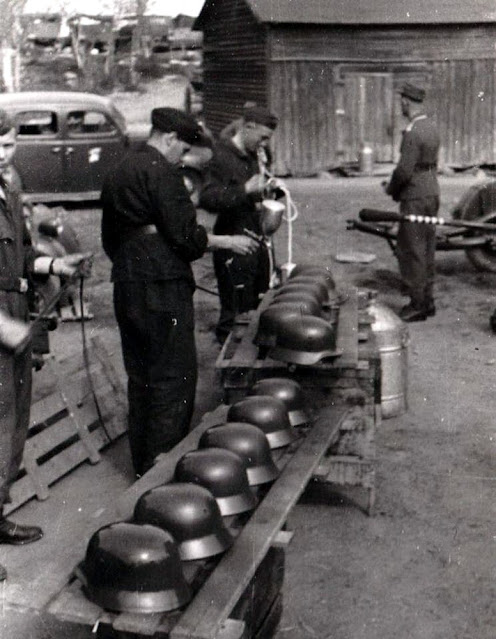
Painting Luftwaffe Helmets

 
From shiney helmets into a Matt finish: nice photo showing a Luftwaffe flak unit (circa 1940/41) painting their helmets to come in line with the 1940 order on helmet paint and decals. The sprayers is wearing HBT reed green Luftwaffe worksuits. It is also a very good photo depicting depot repaints of helmets.

Source :
https://www.facebook.com/LuftwaffeFD/photos/a.114470297207428/314601447194311/

Saturday, September 25, 2021

River Crossing Training

Gebirgsjäger-Regiment 137, April 1940: A river crossing with dinghies is practiced on the Moselle near Treis. They were scheduled to fight against France, but then had to go to Norway. The picture was taken by the member of 6.Kompanie, Rudi Margreiter.

Source :
https://www.flickr.com/photos/arkivinordland/albums/72157627291840604

Sunday, July 25, 2021

Bio of Oberst (Luftwaffe) Joachim Elle

 
Oberstleutnant Joachim Elle, as the Commander of Luftwaffe-Nachrichten-Abteilung 7 (mot.), at Atlantikwall, France, 1940.

Joachim Elle was promoted to Major (E) in Stab / Luftflotte 2 on 1 August 1939. On 6 July 1940 he was promoted to Oberstleutnant and appointed as provisional Kommandeur Luftwaffe-Nachrichten-Abteilung (H) (motorisiert) 7. in December 1941 he became Nafü (Nachrichtenführer) of Jagdfliegerführer 3. On 1 April 1942 he was promoted to Oberst and appointed as Kommandeur Luftwaffe-Nachrichten-Regiment 53. On 14 January 1943 - as the Kommandeur of Luftwaffe-Nachrichten-Regiment 53 and Nafü of Jagdfliegerführer 3 - he became the member of Luftwaffe mission in Romania. In August 1944 he was appointed as Nafü and Kommandeur of German Luftwaffe in Romania. In September 1944 Elle became the Kommandeur of Luftwaffe-Nachrichten-Regiment 211. His last appointment in the war were as the Nafü of 1. Jagddivision on 1 February 1945.


Source :
"Luftwaffe Officer Career Summaries: Section A-F" by Henry L. deZeng IV and Douglas G. Stankey

Thursday, July 1, 2021

Oberst Albin Nake as Commander of Gebirgsjäger-Regiment 136

 
Oberst Abin Nake (right, Kommandeur Gebirgsjäger-Regiment 136 / 2.Gebirgs-Division) in Norway 1940. He would receive the Deutsches Kreuz in Gold on 29 November 1942 as Generalmajor and Führer 97.Jäger-Division. His last rank is Generalleutnant.

Source :
https://www.ebay.de/itm/313573082943?hash=item490269873f:g:H1oAAOSwofxgzzuB

Sunday, June 27, 2021

Bio of Oberst (Luftwaffe) Dr. Otto Sommer

 
Oberst Dr. Otto Sommer (Fliegerhorst-Kommandantur Delmenhorst) in Delmenhorst 1940

A German politician (NSDAP - Nationalsozialistische Deutsche Arbeiterpartei), lawyer and SA Standartenführer, Dr. Otto Sommer (born 22 October 1891) was promoted to Oberst der Luftwaffe on 1 September 1937. He was appointed as Kommandeur of III.Gruppe / Kampfgeschwader 157 to 30 April 1939, then Kommandeur III.Gruppe / Kampfgeschwader 27 to 30 June 1939. After that he was appointed as Kommandant Fliegerhorst-Kommandantur Delmenhorst.

On 18 August 1940 Oberst Sommer was killed when flying as an "observer" with a crew from 9.Staffel / Kampfgeschwader 76 attacking RAF Kenley, when his aircraft (Do17Z-2; F1+HT) was shot down by anti-aircraft fire and crashed at the edge of the airfield, killing all aboard including: Beobachter [observer] Oberleutnant Hans-Siegfried Ahrens, Bordfunker [wireless operator] Feldwebel Karl Greulich, Flugzeugführer [pilot] Feldwebel Johannes Petersen and Bordschütze [air gunner] Unteroffizier Ewald Johannes Dietz.


Source :
"Luftwaffe Officer Career Summaries" by Henry L. deZeng IV and Douglas G. Stankey
https://www.ebay.de/itm/294244638237?hash=item448258de1d:g:NLkAAOSwAbtgHVAz&autorefresh=true
https://www.findagrave.com/memorial/146498026/otto-sommer

Saturday, February 13, 2021

Luftwaffe Ace Kurt Sauer and His Aircraft


Unteroffizier Kurt Sauer of 9.Staffel / III.Gruppe / Jagdgeschwader 53 (JG 53) is sat on the wing leading edge of a Bf 109E from his Staffel that has just been adorned with the ‘Pik-As’ badge. Sauer shot down three aircraft in 1940, and his tally stood at nine by the time he was made a PoW on 16 July 1941. The ‘Pik-As’ emblem was applied to all of JG 53’s aircraft following its adoption by the unit’s new Kommodore, Generalmajor Hans Klein (himself a 22-victory Word War 1 ace), upon him taking over from Oberstleutnant Werner Junck in late October 1939.

Source :
"Jagdgeschwader 53 'Pik'As' Bf 109 Aces of 1940" by Chris Goss & Chris Davey

Friday, July 31, 2020

554. Infanterie-Division at Donaueschingen

This picture was taken on 3 August 1940 at Donaueschingen, Baden-Württemberg, Germany. Generale with the red arrows, from left to right: Generalleutnant z.V. Anton Freiherr von Hirschberg (Kommandeur 554. Infanterie-Division) and Generalleutnant Erwin Oßwald (Kommandierender General Stellvertretendes Generalkommando V. Armeekorps). 2nd from left is Oberstleutnant i.G. Karl Schall (Ia Erster Generalstabsoffizier 554. Infanterie-Division), while at far right is Oberst (E) Erich von Kirchbach (Chef des Generalstabes Stellvertretendes Generalkommando V. Armeekorps). The 554. Infanterie-Division was formed on 15 February 1940 from Divisionstab z.b.V. 441 as part of the 9. Welle (wave). Organized as a static division, it manned the West Wall on the Upper Rhine conducting border security, training and air raid protection duties. After the invasion of France, during which it advanced with the 7. Armee into Alsace, the division was disbanded on 13 August 1940.

Source :
https://www.axishistory.com/other-aspects/150-germany-heer/heer-divisionen/3437-554-infanterie-division
https://forum.axishistory.com/viewtopic.php?p=2282990#p2282990

Thursday, June 25, 2020

Bf 109s of JG 53 vs RAF Hurricanes

On 12 August 1940, Jagdgeschwader 53 (JG 53) was tasked with carrying out a ‘Freie Jagd’ off Portsmouth and the Isle of Wight in support of Ju 88s of KG 51 that were attacking Portsmouth harbour and Ventnor radar station on the Isle of Wight. Leading 1./JG 53 was Hauptmann Hans-Karl Mayer, who was flying a Bf 109E-4 coded ‘White 8’. His Rottenflieger was Unteroffizier Heinrich Rühl in a Bf 109E-1 coded ‘White 10’. Flying at 8500 m, Mayer spotted three Hurricanes below attacking a lone Bf 110 at 1220 hrs, and although he quickly engaged the enemy fighters the Bf 110 pilot bailed out. Mayer selected the right Hurricane and Rühl the left, the former firing a total of 20 20 mm shells and 80 7.92 mm machine gun rounds into the RAF fighter, which immediately burst into flames and dived into the sea for what would be Mayer’s tenth victory of the war. Having already exhausted his supply of cannon shells, Rühl fired 200 machine gun rounds at his Hurricane, which then hit the sea in a gentle curve. Mayer now turned his attention to the remaining Hurricane, which had been engaged by the rest of his Staffel. This combat was not as one-sided, however, for his Bf 109E was hit six times. Mayer’s combat report noted; ‘After my first kill I flew back to the dogfight with the last remaining Hurricane against several aircraft of my Staffel. I immediately attacked and was able to open fire twice, and also received some hits myself. The damaged aircraft tried to escape in the direction of the coast but I stayed close to it, while my Staffel lost me in the haze. At first it made only slight evasive actions, and so I was able to get in several well-aimed bursts. The aircraft started emitting black smoke, went down in a shallow dive and disintegrated on impact.’ Mayer had achieved his second victory of the mission, firing ten cannon and 250 machine gun rounds at the Hurricane, which, after hitting the sea, sank immediately. Although it cannot be said for certain, it is believed that Mayer and Rühl accounted for Plt Off John Harrison, Acting Flt Lt Wilhelm Pankratz and Sgt Josef Kwiecinski of No 145 Sqn, all of whom were reported missing in action off the Isle of Wight at times that matched the three German claims.

Source :
Artwork by Mark Postlethwaite
"Jagdgeschwader 53 'Pik-As' Bf 109 Aces of 1940" by Chris Goss

Friday, January 24, 2020

In the Skies Above Paris

In the skies above Paris… Not really. An army Unteroffizier and his navy buddy have their photo taken in a studio in Paris, 1940. I have seen this very set used in at least one more photo, so I guess it was a rather popular souvenir back then. Those were the happy days being a German soldier. Sure, at least 27,000 of them had been killed in the Battle of France, but the campaign was short and triumphant, and the humiliation of the defeat in 1918 paid back. The war against the Soviet Union was a year off in the future, and instead the German soldiers could enjoy occupation duty in France. There were plans and preparations for the invasion of Britain, Operation Seelöwe, but while the Luftwaffe fought in the skies over England, soldiers on leave had a fun time in Paris. A year and a half later, many of them would be freezing to death on the Eastern Front…


Source :
Photo collection Björn Hellqvist
https://ww2inphotos.wordpress.com/2017/07/28/those-magnificent-men-in-their-flying-machines/