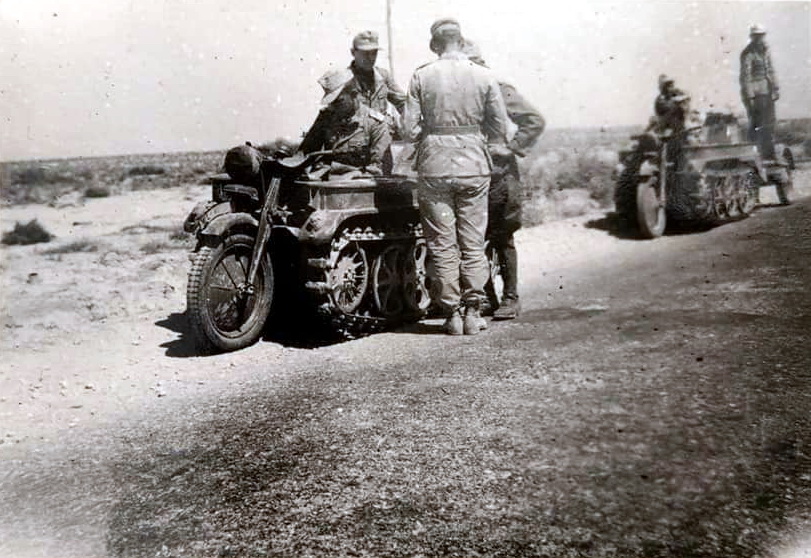
German troops, including a Paratrooper, inspects an Italian anti-aircraft position near Tobruk in 1942. The picture was taken by Kriegsberichter Rechenberg.
Source :
https://www.ww2incolor.com/gallery/german-paratroopers/21535/tobruk
German troops, including a Paratrooper, inspects an Italian anti-aircraft position near Tobruk in 1942. The picture was taken by Kriegsberichter Rechenberg. Captured American Ford 3T truck armed by the Germans with a Flak gun 20mm on the back of the truck. Mareth area, Tunisia, March 1942.
 The 8,8-cm-Flak 36 / 37 anti-aircraft gun is towed by Krass-Maffei's 8-ton Sd.Kfz 7 tractor. This tool was effective weapons against air and ground targets. 1st Battery of the 33rd Anti-Aircraft Artillery Regiment (1./Flak-Rgt.33 (gem.mot.)) Arrived in Cyrenaica on February 10-11, 1941 from France. The 33rd regiment was formed on October 1, 1939 in Hull as part of five batteries with 20 guns. In North Africa, the regiment included three 8,8-cm batteries guns and three batteries of light 2-cm guns Flak 38. During the French campaign in the Battle of Arras, one of the 8,8-cm batteries destroyed five heavy British Matilda tanks, which determined his future fate. 8,8-cm guns became the most important anti-tank weapon in the African campaign. Their shells with an initial speed of 810 m / s could penetrate at a distance of 500 m 110 mm armor mounted at an angle of 60 degrees. This was enough to penetrate 78 mm of the frontal armor of British tanks Matilda from a distance of 1,5 km. They themselves remained outside the reach of their guns, which also had no high-explosive shells.


 The German forces had to adapt to harsh North-African desert conditions and weather. During the summer the temperatures rose to 70°C (158° F) under the sun, while at night, occasionally, it steady froze. Most of the combatants wore warm clothes and took them off when the temperatures got really warm.

Marriage by proxy is one more than a hundred-year-old family law institution, common to the legal systems of many states. Obviously it consists of a marriage in which one of the spouses, who is absent, is replaced by a third party for the issuance of consent; This third party acts as a proxy through a special power that has been legally granted by the absent spouse.
A Law of November 4, 1939 regulated this institution for the Wehrmacht members in campaign. The family book and an affidavit on the Aryan ancestry of the bride and the corresponding civil registry data were required. Over time, a mere written statement was enough.
The ceremony for the bride took place in the office of the civil registry with the presence of two witnesses and was called “Stahlhelmtrauung” or “steel helmet wedding”, since a steel helmet was placed to symbolize the presence of the absent contractor.
The ceremony for the groom took place before an officer of his unit and in the presence of comrades of the contracting party, who acted as witnesses.

Ferntrauung (proxy wedding) in North Africa, 30 April 1942. The comrades share in the joy of the young husband. Photo by Kriegsberichter Otto.
 Ferntrauung (proxy wedding) in North Africa, 30 April 1942. The newly wed shows his comrades the bride's picture. Photo by Kriegsberichter Otto.
Source :
https://www.warrelics.eu/forum/history-research-third-reich-ww2/knights-cross-next-queen-elizabeth-764957-2/#post2072546

 Men of the Australian 9th Infantry Division guard Italians and some of the first German prisoners to be taken during the war in North Africa, after Rommel's first unsuccessful assault on Tobruk, 17 April 1941. If we are talking about Heer Division, it was the 5. leitche-Division during the 1st Siege of Tobruk that was on 10-14 April 1941. However, on the 2nd Siege of Tobruk from 30 April to 7 May 1941 it was a mix between the elements of the 5.leichte-Division and the newly arrived 15. Panzer-Division (except for Panzer-Regiment 8 that was not involved yet). BTW, if someone asking: Why are their heads bowed? It is actually a basic techniek of not to look your captors in their eyes, state only your name and number. Look what happened at Malmedy: at the Nuremberg Trials the SS Soldiers stated in their defense that the American POW’s looked at them tauntingly almost staring them down ... we all know how that ended for the Americans!
Source :
https://www.facebook.com/photo/?fbid=4981605118546865&set=gm.2563691697254982
https://www.iwm.org.uk/collections/item/object/205205791
 A Horch 108 modified with a 20mm Flak 30 anti aircraft gun. The four-leaf clover symbol is belong to 19. Flak-Division. This is the quintessential symbol of good luck in Germany, is of Christian origin. According to Christian legend, when Eve was driven out of the Garden of Eden she took a four-leaf clover with her – to remember the good times in paradise by later on. So market gardens grow millions of potted clover plants for gift-givers at New Year’s. But hardliners say they’re cheating. To really bring good luck your four-leaf clover has to be found in the wild - where exemplars are very few and far between. So whoever does find them must be quite fortunate indeed – in which case good luck comes full circle.
Source :
https://www.facebook.com/photo/?fbid=689595875035925&set=gm.2564221030535382
 S-Minen preparation with a vast array of fuzes (pressure and trip). Mines are for defending but also for slowing down the enemy. Booby traps not forgotten. The picture was taken when the Axis troops were in full retreat in Lybia, December 1942.
Source :
ECPAD Archives, courtesy of Blanluet Christophe
https://www.facebook.com/photo/?fbid=10158979917633308&set=gm.2743536849246876


Source :
ECPAD Archives, courtesy of Blanluet Christophe
https://www.facebook.com/groups/2360048380929060/permalink/2697288740538354/?__cft__[0]=AZUZA9pxWJ5eKRcFQ8-_lWvbpMMxCzhKIMmqIZCvwtkPMvdBilAWalg2Ewd_XRKMsvSEj3BD4EbQlPb1Kl75PH361Zi7fRiO5aavwm9sJvU6XF7wpYwXMQ_-EZ95j8cewjccfNfQB2cV7IRnhi224j0MmMHdj8UCr7kt3DQSy-wN6w&__tn__=%2CO%2CP-R