Sunday, March 12, 2023

Bio of Major Paul Block

Paul Block

Date of Birth: 16.05.1915 - Pommern (German Empire)
Date of Death: unknown

Religion: Evangelist
Father: Eduard Block (priest)
Mother: Frieda Schmidt
Wife: Gisela Leistikow (born 25.09.1921)
Children: Two sons (born in 13.11.1932 and 03.11.1942)

Promotions:
20.04.1936 Leutnant, RDA 01.04.1936 (850)
31.03.1939 Oberleutnant, RDA 01.04.1939 (129)
15.02.1942 Hauptmann, RDA 01.03.1942 (105)
01.03.1944 Major (19a)

Career:
04.06.1934 Entered Infanterie-Regiment 4
16.06.1934 Sworn-in
06.10.1936 Member of II.Bataillon / Infanterie-Regiment 94
26.08.1939 - 27.09.1941 Chef 12.Kompanie / III.Bataillon / Infanterie-Regiment 94
28.09.1941 - 11.06.1942 Chef MG-Kompanie / Infanterie-Regiment 94
15.06.1942 - 19.01.1943 Inspektionschef Schule V für Offiziersanwärter der Infanterie
20.01.1943 - 28.02.1943 Führerreserve OKH
01.03.1943 - 24.03.1943 Stabsoffizier 321. Infanterie-Division
25.03.1943 - 09.11.1943 Adjutant 321. Infanterie-Division
10.11.1943 - 09.12.1943 Führerreserve OKH
10.12.1943 Adjutant 352. Infanterie-Division

Awards and Decorations:
03.10.1939 Eisernes Kreuz II.Klasse
19.08.1941 Eisernes Kreuz I.Klasse
15.12.1941 Infanterie-Sturmabzeichen in Silber

LINK DOCUMENT FILE IN THE GENERALKARTEI


Source:
Bundesarchiv

Sunday, March 5, 2023

Captured US Truck of the Afrikakorps

Captured American Ford 3T truck armed by the Germans with a Flak gun 20mm on the back of the truck. Mareth area, Tunisia, March 1942.

Source :
ECPAD Archive

Saturday, February 18, 2023

Why German Soldiers Fought with their Sleeves Rolled up

To date, there are not so many people left who remember and saw with their own eyes the events of the Second World War, and you and I, the descendants, can only observe the events of those years from documentary chronicles, photographs, or from artistic paintings that were shot in Soviet Union or already in our time.

Surely, many of you have noticed how German soldiers appeared in newsreels with a proud expression on their faces, leisurely walking with an MP40 machine gun in their hands. And almost always their sleeves were rolled up to the elbow, while Soviet soldiers never did this.

What is the reason for such wearing of military clothes. I would like to note right away that in this situation we are not talking about any military traditions. It was all about the form itself.

The fabric from which the German uniform was sewn consisted of two-thirds of wool, the rest of viscose. The quality and characteristics of the appearance of the clothes were at a high level. In the cold season, in this form it was quite warm, but this plus turned into a minus at the same time. Heat transfer is disturbed in woolen products and because of this, it was very hot in a woolen military uniform in the warm season, unlike cotton clothes. Toward the middle of the war, the German uniform began to be sewn, it was from cotton, but the rolling up of the sleeves by the Wehrmacht soldiers on the tunic had already become a habit. Apparently, the charter did not prohibit such wearing of a military uniform, and the officers turned a blind eye to this. However, discomfort in warm weather is not the only reason for rolling up sleeves. We all know that natural wool is a rather prickly material, and those who have worn a wool sweater on their naked body at least once understand what is at stake and remember how the skin itches after that.

As for the soldiers of the Red Army, their uniforms were sewn almost entirely from cotton fabric, as a result of which it was much lighter and more practical. Cotton also breathed well, was a versatile fabric for heat and cold. Plus, the tunics of Soviet soldiers were distinguished by a special cut. The sleeves were slightly tapered, so rolling up the sleeves was quite difficult and impractical.


Source :
https://dzen.ru/media/id/5fdf902d0199050378ad334d/pochemu-nemeckie-soldaty-voevali-zasuchiv-rukava-60771d448fb1c273054dd6bb
https://en.wikipedia.org/wiki/File:German_troops_in_Russia_-_NARA_-_540156_(cropped).tif

Saturday, December 3, 2022

Studio Portrait of Luftwaffe Personnel in Tropical Uniform


Nice original postcard sized Luftwaffe portrait picture with full tropical uniform and a ribbon to the Deutsch-Italienische Erinnerungsmedaille an den Afrika-Feldzug.

Source :
https://fjm44.com/product/luftwaffe-portrait-picture-with-tropical-uniform-and-afrika-ribbon/

Monday, November 28, 2022

Luftwaffe Fighter Pilot in Avignon


Photograph, portrait. Uniformed Luftwaffe fighter pilot. Translated German caption on photo reverse: "Junior fighter pilots learn gunnery. (See leader)/ These young fighter pilots are between school and front. They get the 'finishing touches' in a training group, with multiple air and gunnery exercises under the guidance of experienced fighter pilots. Soon, the beginners will be able to record their first success, when they fly together with the 'old hands' against the enemy. Avignon, 4/10/43." Avignon, France. 4 October 1943.

Source :
https://www.ww2online.org/search-page?f%5B0%5D=field_tgm%3AMilitary%20air%20pilots--German--France

Sunday, November 13, 2022

88 Flak Guns Towed by Sd.Kfz.7

The 8,8-cm-Flak 36 / 37 anti-aircraft gun is towed by Krass-Maffei's 8-ton Sd.Kfz 7 tractor. This tool was effective weapons against air and ground targets. 1st Battery of the 33rd Anti-Aircraft Artillery Regiment (1./Flak-Rgt.33 (gem.mot.)) Arrived in Cyrenaica on February 10-11, 1941 from France. The 33rd regiment was formed on October 1, 1939 in Hull as part of five batteries with 20 guns. In North Africa, the regiment included three 8,8-cm batteries guns and three batteries of light 2-cm guns Flak 38. During the French campaign in the Battle of Arras, one of the 8,8-cm batteries destroyed five heavy British Matilda tanks, which determined his future fate. 8,8-cm guns became the most important anti-tank weapon in the African campaign. Their shells with an initial speed of 810 m / s could penetrate at a distance of 500 m 110 mm armor mounted at an angle of 60 degrees. This was enough to penetrate 78 mm of the frontal armor of British tanks Matilda from a distance of 1,5 km. They themselves remained outside the reach of their guns, which also had no high-explosive shells.

Source :
https://en.topwar.ru/135723-rommel-v-afrike.html
https://warshistory.ru/raznoe-2/rommelya-formula-10.html

Saturday, November 12, 2022

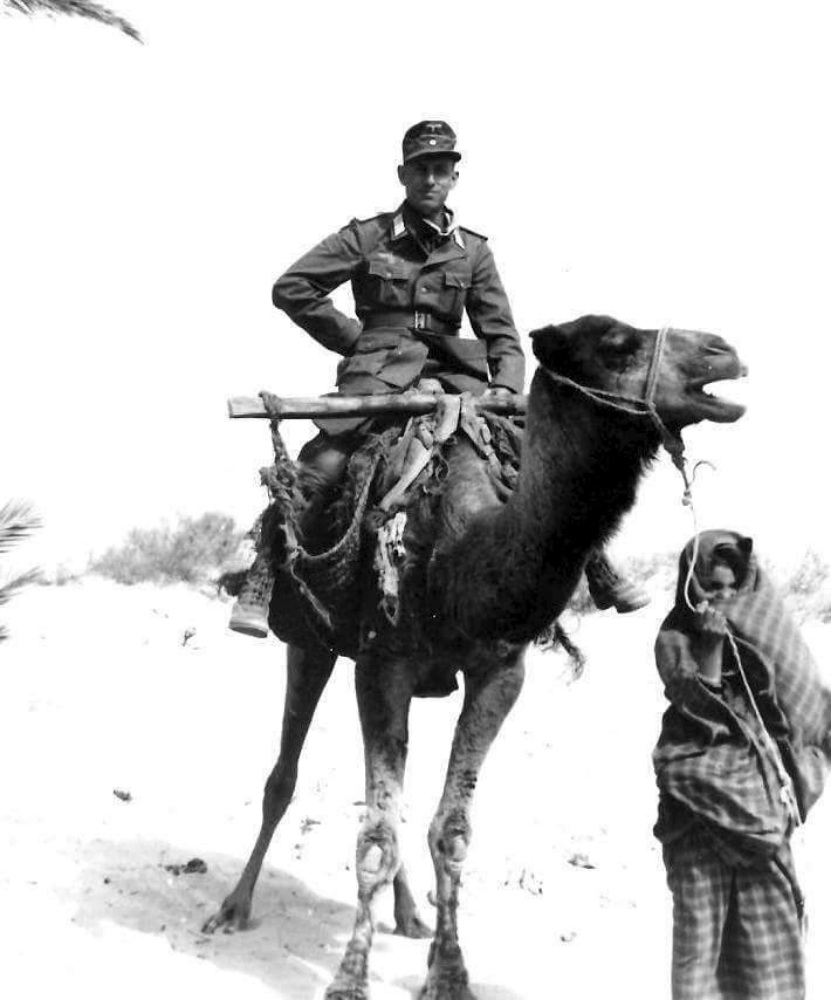
Afrikakorps Soldier on a Camel with a Guide


An Afrikakorps soldier on a camel with a guide. The Germans and Italians more or less left the Arab populations to themselves, so long as they did not interfere with operations in the area. The German command also instructed soldiers not to fraternize with the local populations. However, a sizable number of Arabs volunteered to fight in the Afrika Korps in the ‘Free Arab Legion,’ later in Panzerarmee Afrika, and smaller numbers served as translators or guides.

Source :
http://www.mourningtheancient.com/truth1cb2.htm
https://www.quora.com/How-did-the-Afrika-Korps-and-Italian-troops-treat-local-populations-during-the-North-African-campaign

Wednesday, November 2, 2022

Recruits of the Luftwaffe during a Prayer

Recruits of the Luftwaffe during a prayer, 9 July 1938. The original caption said: "Luftwaffe soldiers have taken off their helmets after the issue of the command 'Helmets off for prayer!'"

Source :
https://www.akpool.de/ansichtskarten/26753519-ansichtskarte-postkarte-deutsche-wehrmacht-luftwaffe-helm-ab-zum-gebet-soldaten-mit-stahlhelmen-und-bajonetten
https://www.alamy.com/stock-photo-recruits-of-the-luftwaffe-during-a-prayer-1938-122549762.html?imageid=8FB962D8-981E-4D84-B5F2-C0C554513477&p=291611&pn=1&searchId=2adb0d94b30ee950bdafece3810c320c&searchtype=0
https://www.arkivi-bildagentur.de/articles/a514634

Tuesday, October 25, 2022

Happy German Soldiers in Yugoslavia

German soldiers, confident of success shortly before the end of combats, in Yugoslavia during Operation Marita, 14 April 1941. The Axis victory was swift. As early as 14 April the Yugoslav high command had decided to seek an armistice and authorised the army and army group commanders to negotiate local ceasefires. That day the commanders of the 2nd and 5th Armies asked the Germans for terms, but were rejected. Only unconditional surrender could form the basis for negotiations they were told. That evening, the high command sent an emissary to the headquarters of the Panzergruppe 1 to ask for armistice, and in response General Ewald von Kleist sent the commander of the 2nd Army, Maximilian von Weichs, to Belgrade to negotiate terms. He arrived on the afternoon of 15 April and drew up an armistice based on unconditional surrender. This picture was taken by Kriegsberichter Artur Grimm and first published in SIGNAL magazine.
 
Source :
https://en.wikipedia.org/wiki/Invasion_of_Yugoslavia
https://id.pinterest.com/pin/352969689554597002/

Sunday, October 23, 2022

Afrikakorps Soldiers with Sand Protector


Goggles, scarves and headdresses were indespensible for blocking sand and the sun, and for preventing sun strokes. The heat often caused mirages. The wind, named "ghibli" by the Italians, could blow at more than 150 km/hours and caused terrible sand-storm, which could last up to three days. The picture was taken by Kriegsberichter Albrecht Heinrich Otto of PK (Propaganda-Kompanie) "Afrika" in April 1941.

Source :
"Deutsche Afrikakorps (1941-1943)" by Ricardo Recio Cardona
https://commons.wikimedia.org/wiki/File:Bundesarchiv_Bild_101I-785-0285-14A,_Nordafrika,_Soldat_mit_Sandschutz.2.jpg

British POW being Questioned by Afrikakorps


April 1941: Rommel wrested more than 800 kilometres from the British forces that were forced to retreat towards Egypt. The men under his command took so many prisoners. In the picture, a British POW is being questioned by german officer.

Source :
NARA - 242-EAPC
"Deutsche Afrikakorps (1941-1943)" by Ricardo Recio Cardona

Afrikakorps Soldiers Wearing Mantel

The German forces had to adapt to harsh North-African desert conditions and weather. During the summer the temperatures rose to 70°C (158° F) under the sun, while at night, occasionally, it steady froze. Most of the combatants wore warm clothes and took them off when the temperatures got really warm.

Source :
NARA - 242-EAPC
"Deutsche Afrikakorps (1941-1943)" by Ricardo Recio Cardona

Saturday, October 22, 2022

Oberleutnant Diekmann of Afrikakorps


Both the sun and washing worked to bleach out the colours of the clothes. The young officer in this picture, dated 3 May 1942, was Oberleutnant Diekmann, aide to General Erwin Rommel of Afrikakorps. The picture was taken by Kriegsberichter Ernst Alexander Zwilling.

Source :
"Deutsche Afrikakorps (1941-1943)" by Ricardo Recio Cardona

Wednesday, October 19, 2022

Luftwaffe Ground Crew Waiting for the Return Bombers

Battle of Britain: Ground staff on the Luftwaffe air base waiting for the return of the bomber squadrons from mission against england, end of August 1940. No further information. Photographer: Artur Grimm.

Source :
https://www.keymilitary.com/article/duel-aces

Saturday, October 15, 2022

RAD Men with He 51 of Fliegergruppe Döberitz

Men of RAD (Reichsarbeitsdienst) are shown around one of the Heinkel He 51 biplanes at Döberitz - presumably aircraft of Jagdgruppe / Fliegergruppe Döberitz. The He 51 was produced between 1934 and 1937, starting 1936 was partly replaced by the Arado Ar 68 and starting 1937 extensively replaced by the Messerschmitt Bf 109 as a Luftwaffe standard fighter aircraft. At this time, the Fliegergeschwader Döberitz received the distinction "Richthofen", but received the final name "JG 2 Richthofen" only on 1 May 1939, under which it later participated in the Second World War.

Source :
https://www.pressreader.com/uk/iron-cross/20220629/281535114675360

Luftwaffe Ace Hans Galubinski


Feldwebel Hans Galubinski of 7.Staffel / III.Gruppe / Jagdgeschwader 53 (JG 53) was credited with eight aircraft destroyed (and a ninth unconfirmed) between 12 May and 6 June 1940, although he was himself shot down on the latter date by Adj Jean Crocq of GC II/1. Assigned to 7./JG 53, Galubinski and his Staffel had taken on 12 MB.152s near Soissons. Three Bloch fighters were destroyed, although Galubinski was in turn shot down after claiming two of his French opponents. The ace was fired on by furious civilians as he descended beneath his parachute, being seriously wounded by shotgun pellets prior to his capture! Galubinski would received the Deutsches Kreuz in Gold on 2 July 1942.

Source :
"Jagdgeschwader 53 'Pik'As' Bf 109 Aces of 1940" by Chris Goss & Chris Davey
https://www.tracesofwar.com/persons/23112/Galubinski-Hans.htm

Fallschirmjäger Training in Norway


At Banak airfield in Norway, a Fallschirmjäger (paratrooper) non-commissioned officer shortly before a joint demonstration with 8./LLG 1 (Lulftlandegeschwader 1). The picture was taken autumn 1943 by Wolfgang Stocker from Kriegsberichterzug XII. Fliegerkorps


Generalmajor Joseph "Beppo" Schmid (facing the camera in the middle, Kommandierender General XII. Fliegerkorps)


Source :
https://imagesdefense.gouv.fr/fr/catalogsearch/advanced/result/?auteur=1509513

Tuesday, October 11, 2022

German Anti-Aircraft Halftrack in Training

Sd.Kfz. 10/4 anti-aircraft half-track with 2 cm Flak 30 gun during training of Heeres Flak-Kompanie, April 1941. The "SdKfz 10 leichter Zugkraftwagen 1 t." (Sonderkraftfahrzeug 10) was a German semi-tracked product produced at 17,000 between 1934/1937 and 1944, capable of carrying eight men, and towing the 3.7-cm Pak 35/36 anti-tank guns; Pak 38 5-cm and Pak 40 7.5-cm; or the 7.5-cm LeIG 18 infantry howitzers; sIG 33 of 15-cm; 12-cm Heavy Granatwerfer 42 mortars; as well as any artillery or Flak pieces with the weight included in the cathegorie of these weapons. The chassis of the "SdKfz 10" was used for the production of the SdKfz 250.
 
Source :
https://id.pinterest.com/pin/tanks--482588916295606544/
https://www.net-maquettes.com/waffen-arsenal/halbketten-fahrzeuge-waffen-arsenal-008/

Thursday, October 6, 2022

Polizei Parade

Two nice postcard sized pictures showing a parade of Gendarmerie members wearing the typical "Tschako". Also notice the flag bearer gorget on one of the portraits.

Source :
https://www.kometmilitaria.com/product-page/2x-postcard-sized-picture-gendermerie-parade

Wednesday, October 5, 2022

General Knochenhauer during Führergeburtstag


Private picture of General der Kavallerie Wilhelm Knochenhauer (right, Kommandierender General X. Armeekorps) posing with two NSDAP officials during Führergeburtstag (Hitler Birthday) celebration, 20 April 1937. The picture was possibly taken in Hamburg.

Source :
https://www.kometmilitaria.com/product-page/private-picture-general-der-kavallerie-wilhelm-knochenhauer